
THE GOSPEL OF MATTHEW (INCLUDING COMMENTARY)
INTRODUCTION
This Gospel early acquired prestige not only because of its intrinsic merits (e.g., the Sermon on the Mount) but because it bore the name of an apostle. It is evident that the evangelist was an early Christian teacher and church leader. The evangelist has several purposes in writing: to instruct and exhort members of his community; perhaps to provide liturgical reading and sermon material; but also, to offer a missionary address to outsiders of good will, as well as to apologetics (apologetics is the religious discipline of defending religious doctrines through systematic argumentation and discourse) and polemics directed to hostile critics and rivals.
We notice in Matthew the five great discourses into which he has gathered so much teaching material, viz: the Sermon on the Mount, the Missionary Discourse, the parable discourse, the Community discourse and the Apocalyptic Judgement discourses.
This Gospel has two focuses, Jesus and the Christ and the near approach of the Kingdom of God which Jesus proclaims. The two themes are closest together at the beginning of the Gospel, where Jesus is set forth as royal Son of God and Immanuel, God with us, and at the end, where Jesus is given all divine authority as Son of Man (shows Christ’s humanity) over the kingdom of God, in heaven and on earth.
The kingdom of God is the great object of hope, prayer and proclamation which unifies the entire gospel, especially the five great discourses, and provides its eschatological horizon and goal. It contains God’s definitive and ultimate promise of salvation to redeemed humanity, on earth as in heaven, in time and eternity, socially and politically as well as personal. It entails justice, peace and joy. Matthew presupposes faith in Christ and tries to provide the community of believers with guidelines and authoritative leaders. Since power is dangerous, though necessary, the leaders need humility.
THE GENEALOGY OF JESUS
A record of the genealogy of Jesus Christ the son of David, the son of Abraham: Abraham was the father of Isaac, Isaac the father of Jacob……………..Matthan the father of Jacob, and Jacob the father of Joseph, the husband of Mary, of whom was born Jesus, who is called Christ.
Thus, there were fourteen generations in all from Abraham to David, fourteen from David to the exile to Babylon, and fourteen from the exile to the Christ.
COMMENTS
The central figure of the book is introduced: Jesus (God saves/ Yahweh, help!); Christ (the anointed)
The son of David here means the end-time successor of King David as the restorer of Israel as God’s people, free and sovereign. The genealogy teaches an important lesson. It briefly incorporates the whole of Old Testament history and thought into the Gospel as the proximate background of Jesus. It says, in effect, if you want to know and understand Jesus, then read the OT. This explains the extreme density of the genealogy (though difficult for the modern reader)
THE BIRTH OF JESUS CHRIST
This is how the birth (incarnation) of Jesus Christ came about: His mother Mary was pledged to be married to Joseph, but before they came together, she was found to be with child through the Holy Spirit. Because Joseph her husband was a righteous man and did not want to expose her to public disgrace, he had in mind to divorce her quietly.
But after he had considered this, an angel of the Lord appeared to him in a dream and said, (annunciation of birth) “Joseph son of David, do not be afraid to take Mary home as your wife, because what is conceived in her is from the Holy Spirit.(virginal conception) She will give birth to a son, and you are to give him the name Jesus, because he will save his people from their sins.”
COMMENTS
(Salvation from sins…oppression, exile and foreign domination often were regarded as a punishment for sins; oppression also involved separation from God since it hindered obedience to the commandments. Jesus will achieve this ‘salvation’ through his death, but also through his proclamation of the kingdom of God)
All this took place to fulfil what the Lord had said through the prophet: “The virgin will be with child and will give birth to a son, and they will call him Immanuel – which means “God with us”
When Joseph woke up, he did what the angel of the Lord had commanded him and took Mary home as his wife. But he had no union with her until she gave birth to a son. And he gave him the name Jesus.
Divine intervention in the birth of God’s chosen was a tradition in Israel’s faith.
COMMENTS
Note Joseph’s obedience to the divine instruction. Joseph was a just man meaning his obedience to the law, but this is tempered by his compassion, which prevents him from wanting to exact the full penalty of the law, stoning.
THE VISIT OF THE MAGI
After Jesus was born in Bethlehem in Judea, during the time of King Herod, who was an extraordinary man with a dominant personality, Magi (wise men normally associated with interpretation of dreams, astrology and magic) from the east came to Jerusalem and asked, “Where is the one who has been born king of the Jews? We saw the star in the east and have come to worship him.” The three wise men were Caspar, Balthasar and Melchior.
When King Herod heard this, he was disturbed, and all Jerusalem with him. When he had called together all the people’s chief priests and teachers of the law, he asked them where the Christ (from the Greek – Joshua, which means the Lord saves) was to be born. “In Bethlehem in Judea,” they replied, “for this is what the prophet (Isaiah 7:14) has written: “But you, Bethlehem, in the land of Judah, are by no means least among the rulers of Judah; for out of you will come a ruler who will be the shepherd of my people Israel.”
Then Herod called the Magi secretly and found out from them the exact time the star had appeared. He sent them to Bethlehem and said, “Go and make a careful search for the child. As soon as you find him, report to me, so that I too may go and worship him.”
After they heard the king, they went on their way, and the star they had seen in the east went ahead of them until it stopped over the place where the child was. When they saw the star, they were overjoyed. On coming to the house, they saw the child with his mother Mary, and they bowed down and worshipped him. Then they opened their treasures and presented him with the gifts of gold (signifying the kingship of Christ) and of incense (his divinity) and of myrrh (his redemptive suffering). And having been warned in a dream not to go back to Herod, they returned to their country by another route.
THE ESCAPE TO EGYPT
When they had gone, an angel of the Lord appeared to Joseph in a dream. “Get up and take the child and his mother and escape to Egypt, stay there until I tell you, for Herod is going to search for the child to kill him.”
So he got up, took the child and his mother during the night and left for Egypt, where he stayed until the death of Herod. And so was fulfilled what the Lord had said through the prophet: “Out of Egypt I called my son.” (Hosea 11:1)
When Herod realised that he had been outwitted by the Magi, he was furious, and he gave orders to kill all the boys in Bethlehem and its vicinity who were two years old and under, in accordance with the time he had learned from the Magi. (a reminiscent of Pharaoh’s command the kill the male offspring of the Israelites) Then what was said through the prophet Jeremiah was fulfilled: “A voice is heard in Ramah, weeping and great mourning, Rachel weeping for her children and refusing to be comforted, because they are no more.”
COMMENTS
Out of Egypt I called my son: the reference is to the basic experience of salvation, the exodus from Egyptian bondage. The ‘son’ in the prophecy is Israel, the people of God. Matthew here applies the exodus typology to an individual, Jesus, who represents the beginning of the restoration of all Israel. The ‘flight’ is a new exodus with a new and greater Moses, Jesus.
THE RETURN TO NAZARETH
After Herod died, an angel of the Lord appeared in a dream to Joseph in Egypt and said, “Get up and take the child and his mother and go to the land of Israel, for those who were trying to take the child’s life are dead.”
So he got up, took the child and his mother and went to the land of Israel. But when he heard that Archelaus was reigning in Judea in place of his father Herod, he was afraid to go there. Having been warned in a dream, he withdrew to the district of Galilee, and he went and lived in a town called Nazareth. So was fulfilled what was said through the prophets: “he will be called a Nazarene.”
JOHN THE BAPTIST PREPARES THE WAY
In those days John the Baptist (a Jewish preacher) came, preaching in the Desert of Judea and saying, “Repent, for the kingdom of heaven is near.” This is he who was spoken of through the prophet Isaiah:
“A voice of one calling in the desert, ‘Prepare the way for the Lord, make straight paths for him’”
John’s clothes were made of camel’s hair, and he had a leather belt round his waist. His food was locusts and wild honey. People went out to him from Jerusalem and all Judea and the whole region of the Jordan. Confessing their sins, they were baptised by him in the Jordan River. (Baptism- to dip or immerse- a religious rite of cleansing and purification)
But when he saw many of the Pharisees (a sect, a religious movement who had become dangerously rigid and exclusivist, and for a certain time opponents of Christianity) and Sadducees (the priestly party connected closely to the temple and thus more directly implicated in the death of Jesus) coming to where he was baptising, he said to them: “You brood of vipers! Who warned you to flee from the coming wrath? Produce fruit in keeping with repentance. (Fruit – good works that go beyond the intentions of repentance are the “follow-through”) And do not think you can say to yourselves, ‘We have Abraham as our father.’ I tell you that out of these stones God can raise up children for Abraham. The axe is already at the root of the trees, and every tree that does not produce good fruit will be cut down and thrown into the fire.
“I baptise you with water for repentance. But after me will come one who is more powerful than I, whose sandals I am not fit to carry. He will baptise you with the Holy Spirit and with fire. His winnowing fork is in his hand, and he will clear his threshing floor, gathering his wheat into the barn and burning the chaff with unquenchable fire.” (Wheat and chaff – harvesting provide images of the separation of the judgement)
THE BAPTISM OF JESUS
Then Jesus came from Galilee to the Jordan to be baptised by John. But John tried to deter him, saying, “I need to be baptised by you, and do you come to me?”
Jesus replied, “Let it be so now; it is proper for us to do this to fulfil all righteousness.” (let it be so now…..expresses a temporal limitation implying a change, after the cross and resurrection , or after the death of John the Baptist) (all righteousness ….to fulfil all justice, to do perfectly whatever is just and makes just, because one is obedient to the will of God) Then John consented.
As soon as Jesus was baptised, he went up out of the water. At that moment heaven was opened, and he saw the Spirit of God descending like a dove and lighting on him. And a voice from heaven said, “This is my son, whom I love; with him I am well pleased.”
COMMENTS
That the Spirit descended on him means that Jesus has been anointed as Messiah, that is, he has received the power, wisdom and holiness for that role. In later Christian tradition the baptism is regarded as the first N.T. revelation of the Trinity, economically, because Father, Son and Spirit are here together, and Jesus’ baptism becomes a model for Christian baptism.
THE TEMPTATION OF JESUS
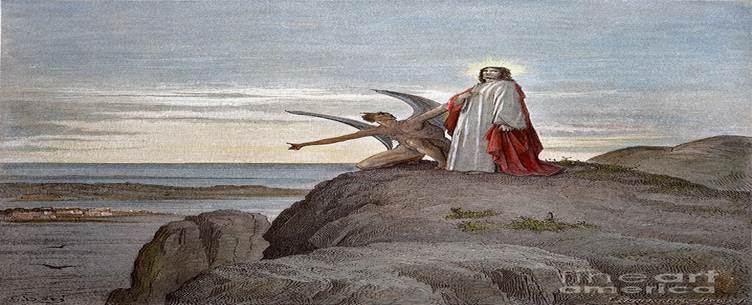
Then Jesus was led by the Spirit into the desert to be tempted by the devil. After fasting for 40 days and 40 nights, he was hungry. The tempter came to him and said, “If you are the Son of God, tell these stones to become bread.”
Jesus answered, “It is written Men does not live on bread alone, but on every word that comes from the mouth of God.” (Deut 6-8)
Then the devil took him to the holy city and had him stand on the highest point of the temple. “If you are the Son of God,” he said, “throw yourself down. For it is written: “He will command his angels concerning you, and they will lift you up in their hands, so that you will not strike your foot against a stone.”
Jesus answered him, “It is also written: ‘Do not put the Lord your God to the test.”
Again the devil took him to a very high mountain and showed him all the kingdoms of the world and their splendour. “All this I will give you,” he said, “If you will bow down and worship me.”
Jesus said to him, “Away from me, Satan! For it is written: ‘Worship the Lord your God and serve him only’”
Then the devil left him, and angels came and attended him.
After fasting for 40 days and 40 nights: Matthew here connects the 40 day fast with Moses and Elijah in the desert and with the great temptation or trial of God’s patience by the people in the Exodus who rebelled against the divine nourishment (manna) and worshiped the golden calf.
COMMENTS
………. but on every word that comes from the mouth of God.”: the word of God is made the chief nourishment.
Son of God: Jesus is addressed as the representative of the people and invited to test God’s providential care by unnecessarily risking his life, a mockery of real martyrdom and the future passion.
The temptation of Jesus has universal significance: (a) Jesus stands for Israel because he is the beginning of the new people of God, the founder of a new humanity; (b) the basic temptation is not to love God with a unified heart, at the risk of life, at the cost of wealth. Jesus is here shown to be the perfect lover of God.
JESUS BEGINS TO PREACH
When Jesus heard that John had been put in prison, he returned to Galilee. Leaving Nazareth, he went and lived in Capernaum, which was by the lake in the area of Zebulun and Naphtali – to fulfil what was said through the prophet Isaiah: “Land of Zebulun and land of Naphtali, (which had fallen to the Assyrians) the way to the sea, along the Jordan, Galilee of the Gentiles – the people living in darkness have seen a great light; on those living in the land of the shadow of death a light has dawned.” (Isaiah’s promise of their liberation, Matthew sees fulfilled by Jesus’ arrival)
From that time on Jesus began to preach, “Repent, for the kingdom of heaven is near.”
COMMENTS
Jesus’ preaching the kingdom is the light of consolation to the suffering people. This proclamation of the near arrival of the kingdom of God is the central message of Jesus and, along with the resurrection, the basis and object of Christian hope. For Christians, the kingdom hope includes faith in Christ as end-time saver. Since Christ has already come in humility and suffering, we have a foretaste of the kingdom especially in the ministry of healing and feeding the multitude, though the fullness is not yet. The kingdom of heaven is not limited to ‘heaven’ but also on ‘earth’ through the gospel message.
THE CALLING OF THE FIRST DISCIPLES
As Jesus was walking beside the Sea of Galilee, he saw two brothers, Simon called Peter and his brother Andrew. They were casting a net into the lake, for they were fishermen. “Come follow me,” Jesus said, “and I will make you fishers of men.” At once they left their nets and followed him.
Going on from there, he saw two other brothers, James son of ~Zebedee and his brother John. They were in a boat with their father Zebedee, preparing their nets. Jesus called them, and immediately they left the boat and their father and followed him.
Gathering disciples is the closest Jesus comes to found a church before the crucifixion
COMMENTS
At once they left their nets and followed him: That Jesus expected a radical, prompt obedience from his followers…yet here the story may have undergone extreme compression; there may have been some chance for a psychological growth in attraction, which would make such an important decision more understandable. In later traditions the nets could be understood as a symbol of worldly entanglements. Following Jesus sometimes means rupturing family ties, yet Jesus opposes neglect of parents in their old age.
JESUS HEALS THE SICK
Jesus went throughout Galilee, teaching in their synagogues, preaching the good news of the kingdom, and healing every disease and sickness among the people. News about him spread all over Syria, and the people brought to him all who were ill with various diseases, those suffering severe pain, the demon possessed, those having seizures, and the paralysed, and he healed them. (The three types of illness are all nervous disorders, psychosomatic, sometimes curable by a strong personality)
Large crowds from Galilee, the Decapolis, Jerusalem, Judea and the region across the Jordan followed him.
THE SERMON ON THE MOUNT (THE BEATITUDES)
Now when he saw the crowds, he went up on a mountainside and sat down. (The mountain is not named, but functionally it is a mountain of revelation, a symbolic Sinai) His disciples came to him, and he began to teach them, saying:
- Blessed are the poor in spirit, for theirs is the kingdom of heaven.
- Blessed are those who mourn, for they will be comforted.
- Blessed are the meek, for they will inherit the earth.
- Blessed are those who hunger and thirst for righteousness, for they will be filled.
- Blessed are the merciful, for they will be shown mercy.
- Blessed are the pure in heart, for they will see God.
- Blessed are the peacemakers, for they will be called sons of God.
- Blessed are those who are persecuted because of righteousness, for theirs is the kingdom of heaven.
Blessed are you when people insult you, persecute you and falsely say all kinds of evil against you because of me. Rejoice and be glad, because great is your reward in heaven, for in the same way they persecuted the prophets who were before you.
COMMENTS
The Sermon on the Mount is Matthew’s masterpiece and was early the most frequently cited section. Biblically, one can consider it to be eschatological, (relating to death, judgement, and the final destiny of the soul and of humankind) ethical, legal wisdom, or law of instruction in view of the kingdom. The dominant theme of the sermon are the kingdom of God and justice. The sermon is systematic, covering the main areas of ethical and religious life as understood in Israel. It is neither purely arbitrary nor exhaustive, but a series of pointers illustrated by focal instances. The sermon has been criticized as setting too high a standard, which remains unfulfillable, but understood against its Jewish background, it becomes a possible but still high standard of moral wisdom about life.
In form, a beatitude is an exclamation of congratulations that recognizes an existing state of happiness. The beatitudes begin with a cry of joy, based on the nearness of the kingdom of God. The original beatitudes about the poor, the mourners and the hungry express Jesus’ mission to the needy in Israel and the dawn of a new era of salvation history. The poor, etc, are happy not because they are morally better than others but because of God’s special care for them. The long last beatitude about the persecuted reflects the experience of martyrdom in the early church and is explicitly Christological.
To the ‘blessed of the poor’ Matthew adds ‘in spirit’. The poor are the needy ones in Israel who prefer the divine service to financial advantage. Their poverty is real and economic, but with a spiritual dimension. The addition of ‘in spirit’ changes the emphasis from social-economic to personal-moral: humility, detachment from wealth, voluntary poverty.
In the Bible economic destitution is an evil to be corrected (Deut 15:11), and wealth is not an evil in itself; indeed, it is a necessity for the well-being of the kingdom, but it risks the neglect of God and of the poor. ‘the meek’ means ‘slow to anger’, ‘gentle with others’ connoting a form of charity. ‘the mourners’…. they mourn to see evil reign on earth; ‘merciful’ refers to the pardon of one’s neighbour, to love esp of the needy and even ‘of one’s enemies.’ All vengeance is excluded, the pure in heart…referring to ritual and moral impurity being cleansed. It stands close to ‘justice’ and includes covenant fidelity, loyalty to God’s commands, sincere worship. ‘peace-making’ is closely related to the love of neighbour and hence to the beatitude of the merciful.
Matthew thus transforms a short messianic manifesto into a program of life, a list of desirable qualities and virtues.
SALT AND LIGHT
“You are the salt of the earth. But if the salt loses its saltiness, how can it be made salty again? It is no longer good for anything, except to be thrown out and trampled by men.”
(Salt cannot lose its flavour and remain salt, but in Judaism it can become unclean and need to be thrown out) (Salt is both a spice and a preservative. So is a good teacher.)
“You are the light of the world. A city on a hill cannot be hidden. Neither do people light a lamp and put it under a bowl. Instead they put it on its stand, and it gives light to everyone in the house. In the same way, let your light shine before men, that they may see your good deeds and praise your
COMMENTS
Father in heaven. (With the confidence of faith, the disciples are not to shrink from their worldly mission. The disciple lives not only for self but for others)
THE FULFILMENT OF THE LAW
Do not think that I have come to abolish the Law or the Prophets; I have not come to abolish them but to fulfil them.( to establish the law by putting it on a better exegetical footing) I tell you the truth, until heaven and earth disappear, ((it asserts the permanence of the law while the physical universe lasts) not the smallest letter, nor the least stroke of a pen, will be any means disappear from the Law until everything is accomplished. Anyone who breaks one of the least of these commandments and teaches others to do the same will be called least in the kingdom of heaven, but whoever practices and teaches these commands will be called great in the kingdom of heaven. For I tell you that unless your righteousness surpasses that of the Pharisees and the teachers of the law, you will certainly not enter the kingdom of heaven.
COMMENTS
Anyone who breaks one of the least of these commandments: – or whoever relaxes…..it teaches that even the small matters of the law are important…yet the verse is careful not to exclude the laxists from the kingdom; they are simply called the least. This reflects a delicate, ecumenical way of fighting: you make your point but do not damn your opponent. (Note that he does not explicitly say that the Pharisees will not enter the kingdom. The verse is a warning to Christians.
MURDER
“You have heard that it was said to the people long ago, ‘Do not murder, and anyone who murders will be subject to judgement. But I tell you that anyone who is angry with his brother will be subject to judgement” (Jesus regards the traditional interpretation as inadequate, though not false. He shifts the ground from the act of murder to the emotional prelude to murder, anger. He thus effects an interiorisation that gets at the roots of moral activity.) (a problem arises today in that modern psychology teaches that neurotically repressed anger is the source of much mental illness. We must be careful therefore, not to think that Jesus is advocating neurotic repression. We should acknowledge our emotions but not act them out in rage or killing or other violence.) Again, anyone who shows contempt to his brother is answerable to the Sanhedrin. But anyone who says, ‘you fool!’ (Empty headed) will be in danger of the fire of hell.
Therefore, if you are offering your gift at the altar and there remember that your brother has something against you, leave your gift there in front of the altar. First go and be reconciled with your brother; then come and offer your gift.
Settle matters quickly with your adversary who is taking you to court. Do it while you are still with him on the way, or he may hand you over to the judge, and the judge may hand you over to the officer, and you may be thrown into prison. I tell you the truth, you will not get out until you have paid the last penny.
ADULTERY
“You have heard that it was said, ‘Do not commit adultery. But I tell you that anyone who looks at a woman lustfully (to desire her) had already committed adultery with her in his heart.
COMMENTS
(Since this verse has troubled many consciences, sometimes unhealthily, it is important to try and grasp its point as exactly as possible. Since adultery is a serious matter, a wrong of injustice as well as of unchastity, acts that lead to it can also be morally seriously wrong ie alienation of affection. They do not condemn any thinking about sexual matters in general)
‘had already committed adultery with her in his heart’ This teaches the truth of experience that when a person has seriously decided to commit a wrong the moral evil is already present, even though it can be increased by further action. (Guilty of intention).
If your right eye causes you to sin, gouge it out and throw it away. It is better for you to lose one part of your body than for your whole body to be thrown into hell. And if your right hand causes you to sin, cut it off and throw it away. It is better for you to lose one part of your body than for your whole body to go into hell. (The logic of one’s decisions and moral choices is important. It is better to sacrifice a part of one’s moral freedom than to lose the whole.)
DIVORCE
It has been said, ‘Anyone who divorces his wife must give her a certificate of divorce.’ But I tell you that anyone who divorces his wife, except of marital unfaithfulness, causes her to become an adulteress, and anyone who marries the divorced woman commits adultery.
The foundations of human society are involved, a grave matter: ‘divorce is to family life what civil war is to the state (Aristotle)’
COMMENTS
Since the matter of divorce is often painful, it is useful to remember that Jesus’ deep intent was not to cause pain but to set out a clear and high ideal of human relations, a vision of marriage as a covenant of personal love between spouses which reflects the covenant relationship of God and his people. Unfortunately, this vision does not always fit the vagaries of the human heart.
In the first century, marriage was significantly different than it is today. Women had little status in society. About the only options they had for supporting themselves were either to be a part of a household (by marrying again) or prostitution. In other words, if a man divorced his wife, really the only option she had for survival involved becoming attached to another man or men. So if he divorces her without good reason, he effectively condemns her to commit adultery. This would have almost certainly not been the most loving thing to do. (However, if she has been unfaithful, the man does not condemn her by divorce because she has already committed adultery.)
Jesus reduced the ordinance of marriage to its primitive institution: They two shall be one flesh, not to be easily separated, and therefore divorce is not to be allowed, except in case of adultery, which breaks the marriage covenant; but he that puts away his wife upon any other pretence, causes her to commit adultery, and him also that shall marry her when she is thus divorced. Note, those who lead others into temptation to sin, or leave them in it, or expose them to it, make themselves guilty of their sin, and will be accountable for it. This is one way of being partaker with adulterers Ps 50 18.
OATHS
Again, you have heard that it was said to the people long ago, ‘Do not break your oath, but keep the oaths you have made to the Lord.’ But I tell you, Do not swear at all: either by heaven, for it is God’s throne, or by the earth, for it is his footstool; or by Jerusalem, for it is the city of the Great King. And do not swear by your head, for you cannot make even one hair white or black. Simply let your ‘yes’ be ‘yes’, and your ‘no’, no; anything beyond this comes from the evil one.
COMMENTS
Jesus implies that there is nothing in creation that is not from God and depending on him, reflecting his glory as creator. Jesus is here opposing the hypocrisy, sophistry, and academic trivialization of life and replacing them with an ideal of simplicity and directness of speech. The Decalogue says, ‘you shall not take the name of God in vain’ and ‘you shall not bear false witness,’ that is, you shall speak the truth in in important matters. Jesus combines the two commandments by saying you shall not swear by God’s name or any substitute for it and you shall speak the truth simply.
AN EYE FOR AN EYE (Retaliation)
You have heard that it was said, ‘eye for eye, and tooth for tooth. But I tell you, Do not resist an evil person. If someone strikes you on the right cheek, turn to him the other also. And if someone wants to sue you and take your tunic, let him have your cloak as well. If someone forces you to go one mile, go with him two miles. Give to the one who asks you, and do not turn away from the one who wants to borrow from you.
COMMENTS
The principal of corresponding restitution remained dominant in legal thinking, an eye for an eye. By the time of Jesus the rabbis already felt it too harsh and began the process of commuting the penalty to fines. ‘do not resist evil’…Jesus teaches non-resistance to evil in the sense of avoiding physical violence or damages. This leaves open the psychological or moral resistance, exemplified by Mahatma Gandhi. Jesus’ teaching is a strategy of winning, not for passive resignation or indifference to evil. The goal is to shame the opponent into a change of heart. This presupposes the requisite dispositions in the opponent, which are not always present. In such difficult cases recourse to other Biblical principles are necessary.
The theme of giving to borrowers goes beyond the scope of non-resistance to evil to advocate general kindness, forbearance, generosity and an open attitude towards people.
LOVE FOR ENEMIES
You have heard it was said. ‘Love your neighbour and hate your enemy. But I tell you: Love your enemies and pray for those who persecute you, that you may be sons of your Father in heaven. He causes his sun to rise on the evil and the good and sends rain on the righteous and on the unrighteous. If you love those who love you, what reward will you get? Are not even the tax collectors doing that? And if you greet only your brothers, what are you doing more than others? Do not even pagans do that? Be perfect, therefore, as your heavenly Father is perfect. (Blameless, conformity to the divine ideal)
COMMENTS
Love your enemies and pray for those who persecute you: this is not hopeless idealism but a wise strategy for overcoming the persecutor. Christianity is not introverted aggression, but aggression transmuted into a strategy for winning through the wisdom of love. If you love those who love you, your reward is an increase in their love. If you love those who hate you, your reward is an increase of God’s love. Loving one’s enemies is an invitation to moral heroism and sanctity. It goes further than ‘do not do unto others what you would not have them do unto you’
GIVING TO THE NEEDY (Almsgiving)
Be careful not to do your ‘acts of righteousness’ before men, to be seen by them. If you do, you will have no reward from your Father in heaven.
So when you give to the needy, do not announce it with trumpets, as the hypocrites do in the synagogues and on the streets, to be honoured by men. I tell you the truth, they have received their reward in full. But when you give to the needy, do not let your left hand know what your right hand is doing, so that your giving may be in secret. Then your Father, who sees what is done in secret. Will reward you.
Whoever wants to publicize his virtue labours not for virtue but for (personal) glory.
PRAYER
“And when you pray, do not be like the hypocrites, for they love to pray standing in the synagogues….to be seen by men. I tell you the truth, they have received their reward in full. But when you pray, go into your room, close the door and pray to your Father, who is unseen. Then your Father, who sees what is done in secret, will reward you. And when you pray do not keep babbling like pagans, for they think they will be heard because of their many words. Do not be like them, for your Father knows what you need before you ask him. This, then, is how you should pray:

For if you forgive men when they sin against you, your heavenly Father will also forgive you. But if you do not forgive men their sins, your Father will not forgive your sins. (Forgiveness is a social necessity if society is not to be paralysed by an accumulation of grievances of one against another.)
COMMENTS
Prayer is the food of faith. It is a sincere personal communion with God and should be brief since he already knows what we need. Addressing God as ‘Our Father’ suggests childlike trust, intimacy and readiness of access. The daily bread has wider meanings. It could refer to daily needs, the messianic banquet, or the Eucharist as a foretaste of the messianic banquet.
FASTING
When you fast, do not look sombre as the hypocrites do, for they disfigure their faces to show men they are fasting. I tell you the truth, they have received their reward in full. But when you fast, put oil on your head and wash your face, so that it will not be obvious to men that you are fasting, but only to your Father, who is unseen; and your Father, who sees what is done in secret, will reward you.
COMMENTS
Fasting was understood as humbling oneself before God, as strengthening prayer and as related to almsgiving (the merit of a fast is in proportion to the charity dispensed,) as an expression of mourning. A fast is directed toward God and not toward human beings and requires faith.
TREASURES IN HEAVEN
Do not store up for yourselves treasures on earth, where moth and rust destroy, and where thieves break in and steal. But store up for yourselves treasures in heaven, where moth and rust do not destroy, and where thieves do not break in and steal. For where your treasure is, there your heart will be also.
The eye is the lamp of the body. If your eyes are good, your whole body will be full of light. But if your eyes are bad, your whole body will be full of darkness. If then the light within you is darkness, how great is that darkness!
No one can serve two masters. Either he will hate the one and love the other, or he will be devoted to one and despise the other. You cannot serve both God and money. (to love God above all things and all other things insofar as they fit into that basic love)
COMMENTS
Here lies the contrast between corruptible and incorruptible treasures. The teaching should not be overly spiritualised (perhaps leading to scruples). It is better understood as referring to treasures that are already experienced in this life but continue to be valuable for eternity, say, honouring father and mother, deeds of loving kindness, making peace between a man and his fellow; and the study of the law leads to them all. If the basic orientation of one’s life, one’s fundamental option, is sound, the overall results will be positive. Perfection should point towards singleness of purpose, purity of heart and undivided loyalty. But often we are two-souled. We must receive this wholeness and harmony of soul, as a gift.
DO NOT WORRY
Therefore, I tell you, do not worry (become preoccupied with) about your life, what you will eat or drink; or about your body, what you will wear. Is not life more important than food, and the body more important than clothes? Look at the birds of the air; they do not sow or reap or store away in barns, and yet your heavenly Father feeds them. Are you not much more valuable than they? Who of you by worrying can add a single hour to his life?
And why do you worry about clothes? See how the lilies of the field grow. They do not labour or spin. Yet I tell you that not even Solomon in all his splendour was dressed like on e of these. If that is how God clothes the grass of the field, which is here today and tomorrow thrown into the fire, will he not much more clothe you, O you of little faith? So do not worry, saying, ‘What shall we drink, eat, wear. For the pagans run after all these things, and your heavenly Father knows you need them. But seek first his kingdom and his righteousness, and all these things will be given to you as well. Therefore, do not worry about tomorrow, for tomorrow will worry about itself. Each day has enough trouble of its own.
COMMENTS
This teaching presupposes Galilean prosperity and would be insensitive in places or situations of destitution (extreme poverty). It perhaps reflects a young person’s interest in discovering the limits of human existence, the real necessities and true values of life. It comments on basic human needs, eating, drinking and clothing, insofar as they can become idols or fetishes. The ultimate goal of our activity must be the highest value, the kingdom of God, which is defined as justice.
JUDGING OTHERS
“Do not judge, or you too will be judged. For in the same way you judge others, you will be judged, and with the measure you use, it will be measured to you.”
Why do you look at the speck of sawdust in your brother’s eye and pay no attention to the plank in your own eye? How can you say to your brother, ‘Let me take the speck out of your eye,’ when all the time there is a plank in your own eye? You hypocrite, first take the plank out of your own eye, and then you will see clearly to remove the speck from your brother’s eye.
COMMENTS
(This verse ‘judge not that you may not be judged’ liberates us from the need to be everyone’s conscience or censor, but it does not free us from all judgement. In adult life we cannot escape the obligation to make some judgement even on the moral character of others. Parents, fiancés, employers, civil judges, church administrators all have this duty. Jesus’ teaching warns against usurping (expropriate) the definite judgement of God, who alone sees the heart. By contrast, our judgement must be tentative, partial and inadequate. But wherever possible, we should try to mind our own business and not meddle in others.
Do not give dogs what is sacred; do not throw your pearls to pigs. If you do, they may trample them under their feet, and then turn and teer you to pieces. (Dogs and swine were considered unclean animals in the Old Testament) ….do not give what is sacred (the kingdom of God) to unlearned men or unsympathetic listeners. Pearls may signify the message of the sermon of the Mount itself)
ASK, SEEK, KNOCK
“Ask and it will be given to you, seek and you will find; knock and the door will be opened to you. For everyone who asks receives; he who seeks finds; and to him who knocks, the door will be opened. (One should above all seek the kingdom of God and justice in prayer)
Which of you, if his son asks for bread, will give him a stone? Or if he asks for a fish, will give him a snake. If you, then, though you are evil, know how to give good gifts to your children, how much more will your Father in heaven give good gifts to those who ask him! So in everything, do to others what you would have them do to you, for this sums up the Law and the Prophets.
THE NARROW AND WIDE GATES
Enter through the narrow gate. For wide is the gate and broad is the road that leads to destruction, and many enter through it. But small is the gate and narrow the road that leads to life, and only a few find it.
These verses express the covenant theology of the two ways, one leading to life, the other to death.
A TREE AND ITS FRUIT
“Watch out for false prophets. They come to you in sheep’s clothing, but inwardly they are ferocious wolves. By their fruit you will recognise them. Do people pick grapes from thornbushes, of figs from thistles? Likewise, every good tree bears good fruit. A good tree cannot bear bad fruit, and a bad tree cannot bear good fruit. Every tree that does not bear fruit is cut down and thrown into the fire. Thus, by their fruit you will recognise them.
Not everyone who says to me, ‘Lord, Lord,’ will enter the kingdom of heaven, but only he who does the will of my Father who is in heaven. Many will say to me on that day, ‘Lord, Lord, did we not prophesy in your name, and in your name drive out demons and perform many miracles? Then I will tell them plainly, ‘I never knew you. Away from me, you evildoers!
COMMENTS
‘Fruits’ are lived faith or ethical conduct, the test of a good person. ‘Prophesy is a spirit related activity. The dominant point here is that no one will emerge triumphant from the last judgement based on right words or spectacular deeds of spiritual power alone. Only a life of love and justice will avail. Matthew’s view challenges Christian complacency and arrogant assurance of salvation.
THE WISE AND FOOLISH BUILDERS
“Therefore, everyone who hears these words of mine and puts them into practice is like a wise man who built his house on the rock. The rain came down, the streams rose, and the winds blew and beat against that house; yet it did not fall, because it had its foundations on the rock. But everyone who hears these words of mine and does not put them into practice is like a foolish man who built his house on sand. The rain came……and it fell with a great crash. (For Matthew following the word of Jesus is wisdom about life)
When Jesus had finished saying these things, the crowds were amazed at his teaching, because he taught as one who had authority, and not as their teachers of the law. (To Matthew Jesus was a figure with a more immediate access both to the Father and to lived reality and to a wider range of biblical tradition than the scribes.)
THE MAN WITH LEPROSY
When he came down from the mountain side, large crowds followed him. A man with leprosy came and knelt before him and said, “Lord, if you are willing you can make me clean.”
Jesus reached out his hand and touched the man. “I am willing,” he said. “Be clean!” Immediately he was cured of his leprosy, Then Jesus said to him, “See that you don’t tell anyone. But go, show yourself to the priest and offer the gift Moses commanded, as a testimony to them.”
COMMENTS
The Bible is rather concerned that miracles do not become a substitute for faith and love. Miracle faith is regarded as an inadequate, but often necessary, starting point to be transcended as quickly as possible. In his ministry as healer-saviour we may say that Jesus used miracles as an attention-getting device as well as an expression of God’s love, compassion, and power to save his people. Miracle stories, however, are useful in showing that reality is not statically fixed and irreformable but open to the transforming power of God and faith. Jesus in these stories also crosses the boundaries of social reality to allow access to salvation even to the outcasts.
THE FAITH OF THE CENTURION
When Jesus had entered Capernaum, a centurion (a leader of 60 to 100 soldiers in the ancient Roman army) came to him, asking for help. “Lord, my servant lies at home paralysed and in terrible suffering.” Jesus said to him, “I will go and heal him.”
The centurion replied, “Lord, I do not deserve to have you come under my roof. But just say the word, and my servant will be healed. For I myself am a man under authority, with soldiers under me. I tell this one. ‘Go,’ and he goes; and that one ‘Come’ and he comes. I say to my servant ‘do this’ and he does it.”
When Jesus heard this, he was astonished and said to those following him, “I tell you the truth, I have not found anyone in Israel with such great faith. I say to you that many will come from the east and from the west and will take their places at the feast with Abraham, Isaac and Jacob in the kingdom of heaven. But the subjects of the kingdom will be thrown outside, into the darkness, where there will be weeping and gnashing of teeth.”
Then Jesus said to the centurion, “Go! It will be done just as you believe it would.” And his servant was healed at that very hour.
The centurion was a Gentile (not a Jew), likely in the service of Herod.
Only say a word…….The centurion’s words shows his politeness, his humility, and his sensitivity to the reluctance of observant Jews to enter the home of a Gentile, lest they encounter ritual defilement.
JESUS HEALS MANY
When Jesus came into Peter’s house, he saw Peter’s mother-in-law lying in bed with a fever. He touched her hand and the fever left her, she got up and began to wait on him. (She is restored to health and to the dignity of active service of Christ)
When evening came, many who were demon-possessed were brought to him, and he drove out the spirits with a word and healed all the sick. This was to fulfil what was spoken through the prophet Isaiah: “He took up our infirmities and carried out diseases.” (Jesus’ healing ministry is endorsed by prophesy.)
THE COST OF FOLLOWING JESUS
When Jesus saw the crowd around him, he gave orders to cross to the other side of the lake. Then a teacher of the law came to him and said, “Teacher, I will follow you wherever you go.”
Jesus replied, “Foxes have holes and birds of the air have nests, but the Son of Man has nowhere to lay his head.” (Jesus answers with a figurative saying which teaches that since he leads a risky, unsettled, itinerant (roaming) way of life, the disciple can expect no better.)
Another disciple said to him, “Lord, first let me go and bury my father,” But Jesus told him, “Follow me, and let the dead bury their own dead.”
COMMENTS
(a powerful teaching on the radical, eschatological, and charismatic character of discipleship to Jesus, which far exceeds the demands of discipleship to a Pharisaic master. For the Christian, discipleship to Jesus must be the number one priority)
JESUS CALMS A STORM
Then he got into a boat and his disciples followed him. Without warning, a furious storm came up on the lake, so that the waves swept over the boat. But Jesus was sleeping. The disciples went and woke him, saying, “Lord, save us! We’re going to drown!” (This has become the prayer of the threatened church of all ages, often depicted in art as a fragile, storm-tossed barque.)
He replied, “You of little faith, why are you so afraid?” Then he got up and rebuked the winds and the waves, and it was completely calm.
The men were amazed and asked, “What kind of man is this? Even the winds and the waves obey him!”
COMMENTS
You of little faith: Little faith presupposes some faith and thus conversion, but suggests a faith grown too weak or paralysed to act. It is the problem of a second or third generation of Christians.
THE HEALING OF TWO DEMON-POSSESSED MEN
When he arrived at the other side in the region of Gadarenes, two demon -possessed men coming from the tombs met him. They were so violent that no-one could pass that way. “What do you want with us, Son of God?” they shouted. “Have you come here to torture us before the appointed time?” (This reflects the intertestamental idea that the demons were free to trouble humanity until the end time)
Some distance from them a large herd of pigs were feeding. The demons begged Jesus, “If you drive us out, send us into the herd of pigs.”
He said to them, “Go!” So, they came out and went into the pigs, and the whole herd rushed down the steep bank into the lake and died in the water. Those tending the pigs ran off, went into the town and reported all this, including what had happened to the demon-possessed men. Then the whole town went out to meet Jesus. And when they saw him, the pleaded with him to leave their region.
COMMENTS
(They pleaded with him to leave not as a way of rejection, but amid confusion and fear at the series of astonishing incidents – not to mention the resentment at the destruction of a herd of animals valuable to them. In this story, the demons have made a double confession, directly that Jesus is the Son of God, indirectly that the swine are as unclean as they themselves are)
JESUS HEALS A PARALYTIC
Jesus stepped into a boat, crossed over and came to his own town. Some men brought to him a paralytic, lying on a mat. When Jesus saw their faith, he said to the paralytic. “Take heart, son; your sins are forgiven.”
At this, some of the teachers of the law said to themselves, “This fellow is blaspheming!” (the Scribes correctly recognise that the forgiveness of sins, which entail an offense against God, belongs to divine activity. Whoever controls the channels of forgiveness in a society controls the society, thus the stakes are high. It is the charge of blaspheming that will in Matthew, eventually get Jesus crucified.)
Knowing their thoughts, Jesus said, “Why do you entertain evil thoughts in your hearts? Which is easier: to say ‘Your sins are forgiven, or to say, ‘Get up and walk? But so that you may know that the Son of Man has authority on earth to forgive sins…..” Then he said to the paralytic, “Get up, take your mat and go home.” And the man got up and went home. When the crowd saw this, they were filled with awe; and they praised God, who had given such authority to men. (Matthew is extending the authority to members of the Church for future generations).
THE CALLING OF MATTHEW
As Jesus went on from there, he saw a man named Matthew sitting at the tax collector’s booth. “Follow me,” he told him, and Matthew got up and followed him. (the immediate obedience to the call is psychologically implausible. Such a response presupposes normally some prior knowledge of Jesus and his mission and some reflection on one’s possible place in that mission.)
When Jesus was having dinner at Matthew’s house, many tax collectors and “sinners” came and ate with him and his disciples. When the Pharisees saw this, they asked his disciples, “Why does your teacher eat with tax collectors and sinners’?” (Sinners- social outcasts) (tax collectors were exploitative)
On hearing this, Jesus said, “It is not the healthy who need a doctor, but the sick. But go and learn what this means: I desire mercy, not sacrifice. For I have not come to call the righteous but sinners.” (an important aspect of the originality and specificity of Jesus’ ministry;)
JESUS QUESTIONED ABOUT FASTING
Then John’s disciples came and asked him, “How is it that we and the Pharisees fast, but your disciples do not fast?”
Jesus answered,” How can the guest of the bridegroom mourn while he is with them? The time will come when the bridegroom will be taken from them; then they will fast. (A formula of prophetic character suggesting a salvation-historical perspective. There are times of Jesus and then the time after Jesus, but the end is not yet. In this in-between time there will be tribulations and thus occasions for fasting.)
“No-one sews a patch of unshrunk cloth on an old garment, for the patch will pull away from the garment, making the tear worse. Neither do men pour new wine into old wineskins. If they do, the skins will burst, the wine will run out and the wineskins will be ruined. No, they pour new wine into new wineskins, and both are preserved.” (a reference here showing the difference between the old (disciples of the Pharisees which are good,) and the new, disciples of Jesus, so that both the old and the new are preserved. The good signifies the fullness of the good through Christ)
A DEAD GIRL AND A SICK WOMAN
While he was saying this, a ruler came and knelt before him and said: “My daughter has just died. But come and put your hand on her, and she will live.” Jesus got up and went with him, and so did his disciples. (here, Matthew heightens the ruler’s faith by having him say that his daughter is already dead when he makes the request)
Just then a woman who had been subject to bleeding for twelve years came up behind him and touched the edge of his cloak. She said to herself, “If I only touch his cloak, I will be healed.”
Jesus turned and saw her. “Take heart, daughter,” he said, “your faith has healed you.” And the woman was healed from that moment.
When Jesus entered the ruler’s house and saw the flute players and the noisy crowd, he said, “Go away. The girl is not dead but asleep.” But they laughed at him. After the crowd had been put outside, he went in and took the girl by the hand, and she got up. News of this spread through all that region.
JESUS HEALS THE BLIND AND MUTE
As Jesus went on from there, two blind men followed him, calling out, “Have mercy on us, Son of David!”
When he had gone indoors, the blind men came to him, and he asked them, “Do you believe that I am able to do this?”
“Yes, Lord,” they replied
Then he touched their eyes and said, “According to your faith will it be done for you”; and their sight was restored. Jesus warned them sternly, “See that no-one knows about this.” But they went out and spread the news about him all over that region.
While they were going out, a man who was demon-possessed and could not talk was brought to Jesus. And when the demon was driven out, the man who had been mute spoke. The crowd was amazed and said, “Nothing like this has ever been seen in Israel,”
But the Pharisees said, “It is by the prince of demons that he drives out demons.” (The Pharisees cannot let this evaluation pass unresisted. The shadow of conflict and of the cross falls over Jesus here. His healings have religious implications)
THE WORKERS ARE FEW
Jesus went through all the towns and villages, teaching, preaching and healing. When he saw the crowds, he had compassion on them, because they were harassed and helpless, like sheep without a shepherd. Then he said to his disciples, “The harvest is plentiful, but the workers are few. Ask the Lord of the harvest, therefore, to send out workers into his harvest field.” (The genesis of Jesus’ commitment to pastoral work is an experience of the people’s need for spiritual leadership.
‘Therefore pray’………only a community that nourishes its faith through powerful prayer is apt to receive and to generate more pastoral workers.
JESUS SENDS OUT THE TWELVE
He called his twelve disciples to him and gave them authority to drive out evil spirits and to heal every disease and sickness.
These are the names of the twelve apostles: first, Simon (who is called Peter) and his brother Andrew; James son of Zebedee, and his brother John; Philip and Bartholomew; Thomas and Matthew the tax collector, James son of Alphaeus and Thaddaeus; Simon the Zealot and Judas Iscariot, who betrayed him.
These twelve Jesus sent out with the following instructions: Do not go among the Gentiles or enter the town of the Samaritans. Go rather to the lost sheep of Israel. As you go preach this message: ‘The Kingdom of Heaven is near.’ Heal the sick, raise the dead, cleanse those who have leprosy, drive out demons. Freely you have received, freely give. Do not take along any gold or silver or copper in your belts; take no bag for the journey, or extra tunic, or sandals or a staff; for the worker is worth his keep. (Lost sheep -marginalised people, alienated from the main circles of religious leadership and zeal) (Freely you have received – the point is that the divine truths of salvation are so important for everyone that they must be taught without regard for the listeners’ ability to pay)
Whatever town or village you enter, search for some worthy person there and stay at his house until you leave. As you enter the home, give it your greeting. If the home is deserving, let your peace rest on it; if it is not, let your peace return to you. If anyone will not welcome you or listen to your words, shake the dust off your feet when you leave that home or town. I tell you the truth, it will be more bearable for Sodom and Gomorrah on the day of judgement than for that town. I am sending you out like sheep among wolves. Therefore, be as shrewd as snakes and innocent as doves. (Whatever town……the missionaries are to depend on local hospitality, to share the life of the people to whom they are sent, with all the risks and inconveniences this entails)
Be on guard against men; they will hand you over to the local councils and flog you in their synagogues. On my account you will be brought before governors and kings as witnesses to them and to the Gentiles. But when they arrest you, do not worry about what to say or how you say it. At that time, you will be given what to say, for it will not be you speaking, but the Spirit of your Father speaking through you. (this verse is sometimes used to excuse not preparing sermons, but the context points only to emergency situations)
Brother will betray brother to death, and a father his child; children will rebel against their parents and have them put to death. All men will hate you because of me, but he who stand s firm to the end will be saved. When you are persecuted in one place, flee to another. I tell you the truth, you will not finish going through the cities of Israel before the Son of Man comes.
“A student is not above his teacher, nor a servant above his master. It is enough for the student to be like his teacher, and the servant like his master. If the head of the house has been called Beelzebub, how much more the members of his household! (the follower of Jesus is to be a life-long student of Jesus, because what he teaches is wisdom about life itself)
“So do not be afraid of them. There is nothing concealed that will not be disclosed or hidden that will not be made known. What I tell you in the dark, speak in the daylight; what is whispered in your ear, proclaim from the roofs. Do not be afraid of those who kill the body but cannot kill the soul. Rather, be afraid of the One who can destroy both soul and body in hell. Are not two sparrows sold for a penny? Yet not one of them will fall to the ground apart from the will of your Father. And even the very hairs of your head are all numbered. So don’t be afraid: you are worth much more than many sparrows. (The ministry of preaching is intrinsically frightening. Only faith in a revealing and judging God can overcome that fear)
“Whoever acknowledges me before men, I will also acknowledge him before my Father in heaven. But whoever disowns me before men, I will disown him before my Father in heaven.
“Do not suppose that I have come to bring peace to the earth. I did not come to bring peace, but a sword. For I have come to turn “a man against his father, a daughter against her mother, a daughter-in-law against her mother-in-law – a man’s enemies will be the members of his own household.’ ( I did not come to bring peace, but a sword…..the sword is not to be understood as implying a zealotic uprising but as a regrettable side-effect of tension and division resulting from the uncompromising proclamation of the kingdom; Elsewhere Jesus declares peacemakers blessed)
“Anyone who loves his father and mother more than me is not worthy of me; anyone who loves his son or daughter more than me is not worthy of me; and anyone who does not take his cross and follow me is not worthy of me. Whoever finds his life will lose it, and whoever loses his life for my sake will find it.
“He who receives you receives me, and he who receives me receives the one who sent me. Anyone who receives a prophet because he is a prophet will receive a prophet’s reward, anyone who receives a righteous man will receive a righteous man’s reward. And if anyone gives even a cup of cold water to one of these little ones because he is my disciple, I will tell you the truth, he will certainly not lose his reward.” (the religious basis of the apostolate deepens by deriving it ultimately from God himself in a cascading succession mediated by Jesus, who is himself the apostle of the Father)
JESUS AND JOHN THE BAPTIST
After Jesus had finished instructing his twelve disciples, he went on from there to teach and preach in the towns of Galilee.
When John heard in prison what Christ was doing, he sent his disciples to ask him, “Are you to one who was to come, or should we expect someone else?”
Jesus replied, “Go back and report to John what you hear and see: The blind receive sight, the lame walk, those who have leprosy are cured……and the good news is preached to the poor. Blessed is the man who does not fall away on account of me.” (Jesus defines his role not as one of sovereignty or judgment, as expected, but as one of blessing on the needy.)
As John’s disciples were leaving, Jesus began to speak to the crowd about John: “What did you go out into the desert to see? A reed swayed by the wind? If not, what did you go out to see? A man dressed in fine clothes? No, those who wear fine clothes are in the king’s palaces. Then what did you go out to see? A prophet? Yes, I tell you, and more than a prophet. This is the one about whom it is written: “I will send my messenger ahead of you, who will prepare your way before you.’ I tell you the truth: Among those borne of women there has not risen anyone greater than John the Baptist; yet he who is least in the kingdom of heaven is greater than he. From the day of John the Baptist until now, the kingdom of heaven has been forcefully advancing, and forceful men lay hold of it. For all the prophets and the Law prophesied John. And if you are willing to accept it, he is the Elijah who was to come. He who has ears, let him hear. (Jesus here asserts the mission of John the Baptist. Up till John the Baptist was a time of prophetic promise; now the time of fulfilment has begun)
To what can I compare this generation? They are like children sitting in the marketplaces and calling out to others: “We played the flute for you, and you did not dance; we sang a dirge, and you did not mourn.’ For John came neither eating or drinking, and they say, ‘He has a demon.’ The Son of Man came eating and drinking, and they say, ‘Here is a glutton and a drunkard, a friend of tax collectors and “sinners”.’ But wisdom is proved right by her actions. (the probable explanation of the parable is that the children are John and Jesus; the call is to play wedding, then the funeral; the ‘others’ are the Palestinian contemporaries, who reject both the severe way of John and the light yoke of Jesus)
COMMENTS
Wisdom is proved right by her actions: “Wisdom is justified by all her children” (Luke 7:35). Both make the same case. The wisdom of Jesus and John the Baptist is demonstrated by the results which come from those actions. It’s not their eating and drinking and dinner companions that matter, it’s the content of their message and what comes from their actions that will prove them to be genuine or not. Both would be fully vindicated by the fulfilment of Jesus’ mission.
WOE TO UNREPENTANT CITIES
Then Jesus began to denounce the cities in which most of his miracles had been performed, because they did not repent. “Woe to you, Korazin! Woe to you, Bethsaida! If the miracles that were performed in you had been performed in Tyre and Sidon, they would have repented long ago in sackcloth and ashes. But I tell you, it will be more bearable in Tyre and Sidon on the day of judgement than for you. And you, Capernaum, will you be lifted up to the skies? No, you will go down to the depths. If the miracles that were performed in you had been performed in Sodom, it would have remained to this day. But I tell you that it will be more bearable for Sodom on the day of judgement that for you.
COMMENTS
Tyre and Sidon were Gentile cities in Phoenicia doomed by the prophets.
The point of the miracles was to provoke national conversion. In this they had failed, and ground for tragedy is laid.
REST FOR THE WEARY
At that time Jesus said, “I praise you Father, Lord of Heaven and Earth, because you have hidden these things from the wise and learned and revealed them to little children. Yes, Father, for this was your good pleasure.
“All things have been committed to me by my Father. No-one knows the Son except the Father, and no-one knows the Father except the Son and those to whom the Son chooses to reveal him.
“Come to me, all you who are weary and burdened, and I will give you rest. Take my yoke upon you and learn from me, for I am gentle and humble in heart, and you will find rest for your souls. For my yoke is easy and my burden light.”
COMMENTS
(The passage consists of a revelation discourse in which Jesus appears as the revealer of divine wisdom. Jesus is the exclusive revelation of the Father. Come to me: here Jesus speaks as Wisdom personified, with feminine characteristics as the giver of rest and comfort, extending the invitation to all who labour. Take my yoke: Jesus is the yoke, Torah, personified. In comparison to the halaka of the Pharisees, Jesus’ teaching is quantitatively easier because shorter and cantered on the essential. But in view of the exceeding righteousness demanded, it is qualitatively more difficult, because the demands of love of God and neighbour are inexhaustible.)
LORD OF THE SABBATH
At that time Jesus went through the cornfields on the Sabbath. His disciples were hungry and began to pick some ears of corn and eat them. When the Pharisees saw this, they said to him, “Look! Your disciples are doing what is unlawful on the Sabbath.”
He answered, “Haven’t you heard what David did when his companions were hungry? He entered the house of God, and he and his companions ate the consecrated bread – which was not lawful for them to do, but only for the priests. Or haven’t you read in the Law that on the Sabbath the priests in the temple desecrate the day and yet are innocent? I tell you that one greater than the temple is here. If you had known what these words mean, ‘ I desire mercy, not sacrifice, you would not have condemned the innocent. For the Son of Man is the Lord of the Sabbath.” (Humanitarian grounds takes precedence over observance)
Going on from that place, he went into their synagogue, and a man with a shrivelled had was there. Looking for a reason to accuse Jesus, they asked him, “Is it lawful to heal on the Sabbath?”
He said to them, “If any of you has a sheep and it falls into a pit on the Sabbath, will you not take hold of it and lift it out? How much more valuable is a man than a sheep! Therefore, it is lawful to do good on the sabbath.”
(Jesus is not anti-Torah or anti- Sabbath, but against the Patristic overdevelopment of sabbath legislation to the point where it becomes, in their own words, “mountains hanging by a hair, for they are very little Bible and a great many rules”)
Then he said to the man, “Stretch your hand,” So he stretched it out and it was completely restored, just a sound as the other. But the Pharisees went out and plotted how they may kill Jesus.
GOD’S CHOSEN SERVANT
Aware of this, Jesus withdrew from that place. Many followed him, and he healed all their sick, warning them not to tell who he was. This was to fulfil what was spoken through the prophet Isaiah: “Here is my servant whom I have chosen, the one I love, in whom I delight; I will put my spirit on him, and he will proclaim justice to the nations. He will not quarrel or cry out; no-one will hear his voice in the streets. A bruised reed he will not break (Divine Gentleness) and a smouldering wick he will not snuff out, till he leads justice to victory. In his name the nations will put their hope.”
The prophecy speaks of God’s love for the Servant; the Servant is Spirit-filled. The images reflect his gentle, quiet care for the weak, the discouraged and the hurt. The finale brightens with a promise of hope and victory.
JESUS AND BEELZEBUB
Then they brought him a demon-possessed man who was blind and mute, and Jesus healed him, so that he could both talk and see. All the people were astonished and said, “Could this be the Son of David?”
But when the Pharisees heard this, they said, “It is only by Beelzebub, the prince of demons, that this fellow drives out demons.” (The growing admiration of Jesus by the people provokes the opposition of the religious leaders) (Since miracles remain ambiguous, the later church largely lost interest in them as a means of theological proof. Yet their popular appeal has usually remained powerful.) (Since Jesus’ specific form of miracle working is expulsion of demons- and this would be counterproductive if he were himself demonic)
Jesus knew their thoughts and said to them, “Every kingdom divided against itself will be ruined, and every city or household divided against itself will not stand. If Satan drives out Satan, he is divided against himself. How then can his kingdom stand? And if I drive out demons by Beelzebub, by whom do your people drive them out? So then, they will be your judges. But if I drive out demons by the Spirit of God, then the kingdom of God has come upon you.
Or again, how can anyone enter a strong man’s house and carry off his possessions unless he first ties up the strong man? Then he can rob his house.
He who is not with me is against me, and he who does not gather with me scatters. And so, I tell you, every sin and blasphemy will be forgiven men, but the blasphemy against the Holy Spirit will not be forgiven. Anyone who speaks a word against the son of man will be forgiven, but anyone who speaks against the Holy Spirit will not be forgiven, either in this age or in the age to come. (Theologically, there is an offer of hope for salvation for the people who lack an explicit faith in Jesus Christ yet who are implicitly open to his saving power through their trust in the Spirit)
Make a tree good and its fruit will be good or make a tree bad and its fruit will be bad, for a tree is recognised by its fruit. You brood of vipers, how can you who are evil say anything good? For out of the overflow of the heart the mouth speaks. The good man brings good things out of the good stored up in him, and the evil man brings out evil things out of the evil stored up in him. But I tell you that men will have to give account on the day of judgement for every careless word they have spoken. For by your words, you will be acquitted, and by your words you will be condemned.”
THE SIGN OF JONAH
Then some of the Pharisees and teachers of the law said to him, “Teacher, we want to see a miraculous sign from you.”
He answered, “A wicked and adulterous generation asks for a miraculous sign! But none will be given it except the sign of the prophet Jonah. For as Jonah was three days and three nights in the belly of a fish, so the Son of Man will be three days and three nights in the heart of the earth. The men of Nineveh will stand up at the judgement with this generation and condemn it; for they repented at the preaching of Jonah, and now one greater than Jonah is here. The Queen of the South will rise at the judgement with this generation and condemn it; for she came from the ends of the earth to listen to Solomon’s wisdom, and now one greater than Solomon is here.
This passage teaches several lessons: (a) the uselessness of looking for spectacular signs; (b) Jonah’s fate as a type of Jesus’ resurrection, a spectacular sign to believers after all; (c) the importance of preaching and repentance; (d) that Gentiles are sometimes more receptive than Jews to God’s messengers; (e) the importance of the quest for divine wisdom, in which women also share and sometimes excel; (f) that Jesus is greater than the previous prophets and wise men, because he is the absolute revelation of the Father.
When an evil spirit comes out of a man, it goes through arid places seeking rest and does not find it. Then it says, ‘I will return to the house I left.’ When it arrives, it finds the house unoccupied, swept clean and put in order. Then it goes and takes with it seven other spirits more wicked than itself, and they go in and live there. And the final condition of that man is worse than the first. That is how it will be with this wicked generation.” (The results of expelling an evil spirit from a person are not necessarily permanent. Trouble can return if one does not fill the empty place left by the departed demon with faith, hope, love and new life)
JESUS’ MOTHER AND BROTHERS
While Jesus was still talking to the crowd, his mother and brothers stood outside, wanting to speak to him. Someone told him, “Your mother and brothers are standing outside, wanting to speak to you.”
He replied to him, “Who is my mother, and who are my brothers?” Pointing (stretching his hand over) his disciples, he said, “Here are my mother and my brothers. For whoever does the will on my Father in heaven is my brother and sister and mother.” (This defines true disciples as those who obey God and act out their faith.)
COMMENTS
(Matthew defines Jesus’ true family as the disciples and accompanies it with a gesture that is almost an ordination. The point of the saying is not to deny natural family ties, but to assert the primacy of intentional ties in the new community which Jesus had begun to gather.)
The Bible reveals that Jesus did have (half) brothers and (half) sisters (they all had the same mother, but not the same father). Mary, by the time her firstborn son’s ministry started, had given birth through Joseph to at least four other boys and at least two girls for a family composed of at least seven children! (The brothers could have been half brothers or not necessarily blood related)
THE PARABLE OF THE SOWER
That same day Jesus went out of the house and sat by the lake. Such large crowds gathered round him that he got into a boat and sat in it, while all the people stood on the shore. Then he told them many things in parables, saying: “A farmer went out to sow his seed. As he was scattering the seed, some fell along the path, and the birds came and ate it up. Some fell on rocky places, where it did not have much soil. It sprang up quickly, because the soil was shallow. But when the sun came up, the plants were scorched, and they withered because they had no root. Other seed fell among thorns, which grew up and chocked the plants. Still other seed fell on good soil, where it produced a crop – a hundred, sixty or thirty times what was sown. He who has ears let him hear.”
The disciples came to him and asked him why he spoke to the people in parables., He replied, “The knowledge of the secrets of the kingdom of heaven has been given to you, but not to them. Whoever has will be given more, and he will have an abundance. Whoever does not have, even what he has will be taken from him. This is why I speak to them in parables: though seeing, they do not see; through hearing, they do not hear or understand. In them is fulfilled the prophecy of Isaiah: “You will be ever hearing, but never understanding; You will be ever seeing but never perceiving. For this people’s heart has become calloused;(hard); they hardly hear with their ears, and they have closed their eyes. Otherwise, they might see with their eyes, hear with their ears, understand with their hearts and turn, and I would heal them.”
“But blessed are your eyes because they see, and your ears because they hear. For I tell you the truth, many prophets and righteous men longed to see what you see but did not see it, and to hear what you hear but did not hear it.
Listen then to what the parable of the sower means: When anyone hears the message about the kingdom and does not understand it, the evil one comes and snatches away what was sown in his heart. This is the seed sown along the path. The one who received the seed that fell on rocky places is the man who hears the word and at once receives it with joy. But since he has no root, he lasts only a short time. When trouble or persecution comes because of the word, he quickly fell away. The one who received the seed that fell among the thorns is the man who hears the word, but the worries of this life and the deceitfulness of wealth choke it, making it unfruitful. But the one who received the seed that fell on good soil is the man who hears the word and understands it. He produces a crop, yielding a hundred, sixty or thirty times what was sown.”
COMMENTS
We could surmise (suppose it is true without any hard evidence) that the sower is either God, Jesus, one of God’s emissaries, even Lady Wisdom. The seed is the divine revelation or the kingdom of God. The different soils represent the different human receptions. The message is that, despite some failures, the sower’s work ultimately succeeds for the most part. The sign of success is the fruit bearing of the recipients. The story gives hope and encouragement. The parable intends to show that ‘if you open yourself in faith and hope to God’s revelation of his plan of salvation, you can make rapid progress in understanding it. If you close yourself to it, you can lose the offer.’ Failing to receive the word is not a failure of hearing but of understanding. Only one who loves God with heart, soul and strength (wealth) truly receives his word.
THE PARABLE OF THE WEEDS
‘The kingdom of heaven is like a man who sowed good seed in his field. But while everyone was sleeping, his enemy came and sowed weeds among the wheat, and went away. When the wheat sprouted and forms ears, then the weeds also appeared.
The owners’ servants came to him and said, ‘Sir, didn’t you sow good seed in your field? Where did the weeds come from?
An enemy did this…he replied.
The servants asked him …….’do you want us to go and pull them up?
No, he answered, because while you are pulling the weeds, you may root up the wheat with them. Let both grow together until the harvest. At that time, I will tell the harvesters: First collect the weeds and tie them in bundles to be burned; then gather the wheat and bring it into my barn. (patience and tolerance until the final sorting)
THE PARABLE OF THE WEEDS EXPLAINED
The one who sowed the good seed is the Son of Man. The field is the world, (humanity) and the good seed stands for the sons of the kingdom. The weeds are the sons of the evil one, and the enemy who sows them is the devil. The harvest is the end of the age, and the harvesters are angels. (The kingdom of God is given to the Son of Man, and he will bring it to earth in its fullness…at the close of the age)
As the weeds are pulled up and burned in the fire, so it will be at the end of age. The Son of Man will send out his angels, and they will weed out of his kingdom everything that causes sin and all who do evil. They will throw them into the fiery furnace, where there will be weeping and gnashing of teeth. Then the righteous (the just …rather than the wise) will shine like the sun in the kingdom of their Father. He who has ears let him hear.
COMMENTS
The kingdom is a mixed body of saints and sinners on earth, until the final sifting by God’s agents. Therefore, patience, tolerance, and forbearance are necessary. The attitude that nothing can be done about the evil in our midst would lead to passive indifference. The Church needs constant reformation and positive action including the quest for holiness yet must avoid unrealistic purism or angelism.
The parable of the Mustard seed and the yeast
The kingdom of heaven is like a mustard seed…though it is the smallest of all your seeds, yet when it grows, it is the largest of garden plants and becomes a tree…so the birds can come and perch in its branches. (The point of this parable of the mustard seed is the sudden surprising shift from the near invisibility of the kingdom to its full grandeur and its universal, all-embracing hospitality)
The kingdom of heaven is like yeast that a woman took and mixed into a large amount of flour until it worked all through the dough. (The point here is that Jesus uses the yeast representing a small movement and yet the surprising effect it can have on all society – God’s plan working almost invisibly to bring about its purposes)
A side effect of this parable is that it is possible to see God present and active in everyday things if one looks at them with wonder.
THE PARABLES OF THE HIDDEN TREASURE AND THE PEARL
The kingdom of heaven is like a treasure hidden in a field. When a man found it, he hid it again, and then in his joy went and sold all he had and bought that field.
Again, the kingdom of heaven is like a merchant looking for fine pearls. When he found one of great value, he went away and sold everything he had and bought it.
The kingdom is such a priceless treasure that a wise man would gladly give all for the chance to seize it. It is the chance of a lifetime. Half measures will not do for the kingdom of God.
THE PARABLE OF THE NET
Once again, the kingdom of heaven is like a net that was let down into the lake and caught all kinds of fish. When it was full the fishermen pulled it up on the shore. Then they sat down and collected the good fish in baskets but threw the bad away. This is how it will be at the end of age. The angels will come and separate the wicked from the righteous and throw them in to the fiery furnace, where there will be weeping and gnashing of teeth….. “He said to them: Therefore, every teacher of the law who has been instructed about the kingdom of heaven is like the owner of a house who brings out of his storeroom new treasures as well as old” (new treasures as well as old: the most common view takes the old as the O/T, the new as Jesus’ teaching about the kingdom)
A PROPHET WITHOUT HONOUR
Coming to his hometown, Jesus began teaching the people in their synagogue, and they were amazed. “Where did this man get his wisdom and these miraculous powers?”…Isn’t this the carpenter’s son…Where did this man get all these things….and they took offence at him.
But Jesus said to them, “Only in his hometown and in his own house is a prophet without honour.” And he did not do (voluntary and free decision) many miracles there because of their lack of faith.
(Jesus’ countrymen fail to perceive God’s presence in him simply because they know his humble human origins and context, of which they are a part. In despising him they despise themselves.)
JOHN THE BAPTIST BEHEADED
At that time Herod the tetrarch heard the reports about Jesus, and he said to his attendants, “This is John the Baptist; he has risen from the dead! That is why miraculous powers are at work in him.”
Now Herod had arrested John and bound him and put him in prison because of Herodias, his brother Philip’s wife, for John had been saying to him: “It is not lawful for you to have her.” (John had judged that Herod had sinned by taking his brother’s wife while his brother was still alive, thereby committed adultery and incest, prohibited in Lev) Herod wanted to kill John, but he was afraid of the people, because they considered him a prophet.
On Herod’s birthday, the daughter of Herodias danced for them and pleased Herod so much that he promised with an oath to give her whatever she asked. (this oath may have been binding in law, to break it would involve perjury) Prompted by her mother, she said, “Give me here on a platter the head of John the Baptist.” The king was distressed , but because of his oaths and his dinner guests, he ordered that her request be granted and had John beheaded in prison. His head was brought in on a platter and given to the girl, who carried it to her mother. John’s disciples came and took his body and buried it. Then they went and told Jesus.
JESUS FEEDS THE FIVE THOUSAND
When Jesus heard what had happened, he withdrew by boat privately to a solitary place. Hearing of this, the crowds followed him. When Jesus landed and saw a large crowd, he had compassion on them and healed their sick.
As evening approached , the disciples came to him and said, “this is a remote place, and it’s already getting late. Send the crowds away, so that they can go to the villages, and buy themselves some food.”
Jesus replied. “They do not need to go away. You give them something to eat.” (Jesus trains the disciples to have self- confidence, to show initiative, to be leaders)“We have here only five loaves of bread and two fish,” they answered.
Bring them here to me, he said. And he directed the people to sit down on the grass. Taking the five loaves and the two fish, and looking up to heaven, he gave thanks and broke the loaves. (he blessed, broke and gave: the ritual of the daily Jewish meal; but the formula points out to the last supper) Then he gave them to his disciples, and the disciples gave them to the people. They all ate and were satisfied, and the disciples picked up twelve basketfuls of broken pieces that were left over.
COMMENTS
(The baskets represent the twelve tribes under the twelve disciples. The feedings anticipate the eucharist, and the eucharist anticipates the messianic banquet in the kingdom) The number of those who ate was about five thousand men, besides women and children.
JESUS WALKS ON THE WATER
Jesus made his disciples get into the boat and go ahead of him, while he dismissed the crowd. After he went up on a mountainside by himself to pray. (Jesus’ solitary nocturnal prayer is a model for Christians, who besides prayer in common also at times need periods of silent personal prayer in contact with nature) When evening came, he was there alone, but the boat was already a considerable distance from land, buffered by the waves because the wind was against it. (In this ideal scene the wind represents the hostile forces of the world)
During the fourth watch of the night Jesus went out to them, walking on the lake. (the Lord overcomes the waves of death) When the disciples saw him walking on the lake they were terrified. “It’s a ghost.” they said and cries out in fear.
But Jesus immediately said to them: “Take courage! It is I. Don’t be afraid.” (I am, Jesus shares in the divine power to save)
“Lord, if it is you,” Peter replied, “tell me to come to you on the water” (Peter’s combination of impulsive love and faith weakened by doubt)
“Come,” he said.
Then Peter got down out of the boat, walked on the water and came towards Jesus. But when he saw the wind, he was afraid and, beginning to sink, cried out, “Lord, save me!”
Immediately Jesus reached out his hand and caught him. “You of little faith, why did you doubt”.
And when they climbed into the boat, the wind died down. Then those who were in the boat worshipped him, saying, “Truly you are the son of God.”
When they had crossed over, they landed in Gennesaret…..there people brought all their sick to him and begged him to let the sick just touch the edge of his cloak, and all who touched him were healed.
CLEAN AND UNCLEAN
Then some Pharisees and teachers of the law came to Jesus from Jerusalem and asked, “Why do your disciples break the tradition of the elders? They don’t wash their hands before they eat!”
Jesus replied, “And why do you break the command of God for the sake of your tradition? For God said, “Honour your father and mother…. and anyone who curses his father or mother must be put to death.” But you say that if a man says to his father or mother, “Whatever help you might otherwise have received from me is a gift devoted to God,” he is not to ‘honour his father’ with it. Thus, you nullify the word of God for the sake of your tradition. You hypocrites! Isaiah was right when he prophesied about you: these people honour me with their lips, but their hearts are far from me. They worship me in vain; their teachings are but rules taught by men…
Jesus called the crowd to him and said, “Listen and understand. What goes into a man’s mouth does not make him unclean, but what comes out of his mouth, that is what makes him unclean. The disciples told Jesus that the Pharisees were offended by this.
He replied, “Every plant that my heavenly Father has not planted will be pulled up by the roots. Leave them; they are blind guides. If a blind man leads a blind man, both will fall into the pit.”
Peter said, “Explain the parable to us”.
“Are you still so dull?” Jesus asked them. “Don’t you see that whatever enters the mouth goes into the stomach and then out of the body? But the things that come out of the mouth come from the heart, and these make a man unclean……for out of the heart come evil thoughts, murder, adultery, sexual immorality, theft, false testimony, slander. These are what makes a man unclean; but eating with unwashed hands does not make him ‘unclean’.
To love God with heart, soul and wealth as the guiding light for all legal observance.
THE FAITH OF THE CANAANITE WOMAN
Jesus withdrew to the region of Tyre and Sidon. A Canaanite woman (a Gentile and hence unclean) from that vicinity came to him, crying out, “Lord, Son of David, have mercy on me! My daughter is suffering terribly from demon- possession.”
Jesus did not answer a word. So his disciples came to him and urged him, “Send her away, for she keeps crying out after us.”
He answered, “I was sent only to the lost sheep of Israel.”
The woman came and knelt before him. “Lord, help me!” she said.
He replied, “It is not right to take the children’s bread and toss it to their dogs.” (Note: Jesus did not wish to exceed his divine mission except to the lost sheep of the house of Israel…that is…. His mission to gather all Israel for the end time events. Also, let the children first be fed…(which includes a salvation-historical perspective, first the Jews, then the Gentiles.)
“Yes, Lord,” she said, “but even the dogs eat the crumbs that fall from their masters’ table.” (Note: the woman is quick to pick up the imagery of Jesus’ reply and twist it to her advantage, yet without arrogance. (Bold humility)
Then Jesus answered, “Woman, you have great faith! Your request is granted.” And her daughter was healed from that very hour.
JESUS FEEDS THE FOUR THOUSAND
Jesus left there and went along the Sea of Galilee. Then he went up on a mountainside and sat down. Great crowds came to him, bringing the lame, the blind, the crippled, the mute and many others, and laid them at his feet. And he healed them. The people were amazed and praised the God of Israel. (note: the people healed are possibly Gentiles, so that through Jesus’ ministry they become part of regathered Israel.)
Jesus had compassion on the crowd and told the disciples that he did not want to send the crowd away hungry. His disciples said to him, “where could we get enough bread in this remote place (remembrance of the desert and the manna) to feed such a crowd.”
“How many loaves do you have?” Jesus asked.
“Seven, and a few small fish”
He told the crowd to sit down on the ground. Then he took the seven loaves and the fish, and when he had given thanks, he broke them and gave them to his disciples, and they in turn to the people.(Eucharistic presence) They all ate and were satisfied. Afterwards the disciples picked up seven basketfuls of broken pieces that were left over. (seven baskets. The number recalls the nations of Canaan) The number of those who ate was four thousand, besides women and children. After Jesus had sent the crowd away, he got into the boat and went to the vicinity of Magadan.
THE DEMAND FOR A SIGN
The Pharisees and Sadducees (two hostile parties symbolising Jewish leadership in opposition of Jesus) came to Jesus and tested him by asking him to show them a sign from heaven.
He replied, “When evening comes you say, ‘it will be fair weather, for the sky is red, and in the morning, “Today it will be stormy, for the sky is red and overcast.’ You know how to interpret the appearance of the sky, but you cannot interpret the signs of the times.
COMMENTS
(Agrarian discernment about the weather should lead to be a model for discernment about God’s activity in history in his agent Jesus, but it often does not) (the signs of the times: God gives hints of his will is each age, but believers mush be attentive to them , a challenge for the Church) A wicked and adulterous generation looks for a miraculous sign, but none will be given it except the sign of Jonah.” Jesus then left them and went away. (The phrase “sign of Jonah” was used by Jesus as a typological metaphor for His future crucifixion, burial, and resurrection.)
THE YEAST OF THE PHARISEES AND SADDUCEES
When they went across the lake, the disciples forgot to take bread, “Be careful,” Jesus said to them. “Be on your guard against the yeast (leaven as a symbol for corruption) of the Pharisees and Sadducees.”
They discussed this among themselves and said. “It is because we didn’t bring any bread.”
Aware of their discussion, Jesus asked, “You of little faith, why are you talking among yourselves about having no bread? Do you still not understand? Don’t you remember the five loaves for the five thousand, and how many basketfuls you gathered? How is it you do not understand that I was not talking to you about bread? But be on your guard against the yeast of the Pharisees and Sadducees.”
Then they understood that he was not telling them to guard against the yeast used in bread, but against the teaching of the Pharisees and the Sadducees. (For Matthew a good disciple is one who understands and remains faithful to the teaching of Jesus as opposed to that of the emerging rabbinate, and as opposed to any nostalgia for the temple as represented by the Sadducees.)
PETER’S CONFESSION OF CHRIST
Jesus came to the region of Caesarea Philippi, and asked his disciples, “Who do people say the son of Man is?”
They replied, “Some say John the Baptist, others say Elijah; and still others Jeremiah or one of the prophets.”
But what about you? Who do you say I am?
Simon Peter answered, “You are the Christ, the Son of the living God”. (invoking the Father/Son relationship)
Jesus replied, “Blessed are you, Simon of Jonah, for this was not revealed by you by man, but be my Father in heaven. And I tell you that you are Peter, and on this rock, I will build my Church, and the gates of Hades (gates of hell) will not overcome it. I will give you the keys of the kingdom of heaven; whatever you bind on earth will be bound in heaven, and whatever you loose on earth will be loosed in heaven.” Then he warned his disciples not to tell anyone that he was the Christ.
COMMENTS
I will build my Church….the church is related to the kingdom, the church is an interim arrangement which mediates salvation in the time between the earthly ministry of Jesus and the future coming of the kingdom.
whatever you bind on earth… This verse gives enormous authority to Peter. Binding and loosing are rabbinic technical terms that can refer to binding the devil in exorcism to the juridical acts of excommunication and of definitive decision making.
JESUS PREDICTS HIS DEATH
From that time on Jesus began to explain to his disciples that he must go to Jerusalem and suffer many things at the hands of the elders, chief priests and teachers of the law, and that he must be killed and on the third day be raised to life. (Prediction of the passion) (Jerusalem is the city where the prophets die)
Peter took him aside and began to rebuke him, “Never, Lord!” he said. “This shall never happen to you!”
Jesus turned and said to Peter, “Get behind me, Satan! You are a stumbling block to me; you do not have in mind the things of God, but the things of men.” (Peter wants only a theology of grace and glory, to separate Christ from the cross)
Then Jesus said to his disciples, “If anyone would come after me, he must deny himself and take up his cross and follow me. For whoever wants to save his life will lose it, but whoever looses his life for me will find it. What good will it be for a man if he gains the whole world, yet forfeits his soul? Or what can a man give in exchange of his soul? For the Son of Man is going to come in his Father’s glory with his angels, and then he will reward each person according to what he has done. I tell you the truth, some who are standing here will not taste death before they see the Son of Man coming in his kingdom.” (an apocalyptic picture of the rewards of discipleship)
(Self-denial means submission of one’s will to God’s. The above express a profound psychological truth that happiness eludes those who seek it directly rather than seeking first the will of God.)
THE TRANSFIGURATION
After six days Jesus took with him Peter, James and John the brother of James, and led them up a high mountain (mountain symbolic of revelation) by themselves. There he was transfigured before them. His face shone like the sun, and his clothes became as white as the light. Just then there appeared before them Moses and Elijah, talking with Jesus. (Moses’ representative of the law and Elijah representative of the prophets)
Peter said to Jesus, “Lord, it is good for us to be here, If you wish I will put up three shelters – one for you, one for Moses and one for Elijah.”
While he was still speaking, a bright cloud enveloped them, and a voice from the cloud said, “this is my Son, whom I love; with him I am well pleased. Listen to him!”
When the disciples heard this, they fell face down to the ground, terrified. (their fear because of the divine command rather than the vision itself) But Jesus came and touched them. “Get up..do not be afraid” When they looked up they saw no-one except Jesus. (Jesus touch overcomes their fear and perhaps consecrates them to further service)
As they were coming down the mountain, Jesus instructed them, “Don’t tell anyone what you have seen, until the Son of Man has been raised from the dead.”
The disciples asked him, “Why then do the teachers of the law say that Elijah must come first?”
Jesus replied, “To be sure, Elijah comes and will restore all things. But I tell you, Elijah has already come, and they did not recognise him, but have done to him everything they wished. In the same way the Son of Man is going to suffer at their hands.” Then the disciples understood that he was talking to them about John the Baptist.
THE HEALING OF A BOY WITH A DEMON
When they came to the crowd, a man approached Jesus and knelt before him. “Lord, have mercy on my son,” he said. “He has seizures (epilepsy) and is suffering greatly. He often falls into the fire or into the water. I brought him to you disciples, but they could not heal him.”
“O unbelieving and perverse generation,” Jesus replied, “how long shall I stay with you? How long shall I put up with you? Bring the boy here to me.” Jesus rebuked the demon, and it came out of the boy, and he was healed from that moment.
Then the disciples came to Jesus in private and asked, “Why couldn’t we drive it out?” He replied, “Because you have so little faith. I tell you the truth, if you have faith as small as a mustard seed, you can say to this mountain, ‘Move from here to there’ and it will move. Nothing will be impossible for you.” ( Other texts re deliverance…this kind does not go out except by prayer and fasting) (The disciples have a faith of understanding and assent but not sufficient trust……..nothing will be impossible….the whole episode thus becomes an instruction to the disciples on the power of trusting faith)
When they came together in Galilee, he said to them, “The Son of Man is going to be betrayed into the hands of men. They will kill him, and on the third day he will be raised to life.” And the disciples were filled with grief.
THE TEMPLE TAX
After Jesus and his disciples arrived in Capernaum, the collectors of the two- drachma tax came to Peter and asked, “Doesn’t your teacher pay the temple tax?” (Presumably tax for the upkeep of the temple)
“Yes, he does” he replied.
When Peter came into the house, Jesus was the first to speak. “What do you think Simon? From whom do the kings of the earth collect duty and taxes – form their own sons or from others?”
“From others,” Peter answered.
“Then the sons are exempt,” Jesus said to him. (exempt from Roman Authority) (“Jesus responded that neither He nor his disciples needed pay the temple tax because they are the children of God and the temple was their Father’s house, so as sons they were exempt. Yet despite this, Jesus agreed to pay this voluntary temple tax so not to cause offense.) But so that we may not offend them, go to the lake and throw out your line. Take the first fish you catch; open its mouth and you will find a four-drachma coin. Take it and give it to them for my tax and yours.” (out of a sense of ecumenical diplomacy and pastoral good sense)
THE GREATEST IN THE KINGDOM OF HEAVEN
At that time the disciples came to Jesus and asked, “Who is the greatest in the kingdom of heaven?
He called a little child and had him stand among them. And he said, “I tell you the truth, unless you change and become like little children, you will never enter the kingdom of heaven. Therefore, whoever humbles himself like this child is the greatest in the kingdom of heaven. ( a child – a child serves as a symbol for humility, not because children are naturally humble, but because they are dependent) ( to humble oneself – is to set a self-imposed limit; self-regulation checks the tendency to arrogance built into positions of authority.)
And whoever welcomes a little child like this in my name welcomes me. But if anyone causes one of these little ones who believe in me to sin, it would be better for him to have a large millstone hung around his neck and to be drowned in the depths of the sea.
Woe to the world because of the things that cause people of sin! Such things must come, but woe to the man through whom they come! If your hand or your foot causes you to sin, cut it off and throw it away.
COMMENTS
(Such things must come, but why? God created people with moral freedom and the capacity for moral struggle and mutual influence, and they have, as a matter of experience, used that freedom to sin.) It is better to enter your life maimed or crippled than to have two hand or two feet and be thrown into the fire. And if your eye causes you to sin, gouge it out and throw it away. It is better for you to enter life with one eye than to have two eyes and be thrown into the fire of hell.
THE PARABLE OF THE LOST SHEEP
“See that you do not look down on one of these little ones. (the little ones are minor community members, and the warning is against the arrogance of leaders) For I tell you that their angels in heaven always see the face of my Father in heaven.
“What do you think? If a man owns a hundred sheep, and one of them wanders away, will he not leave the ninety-nine on the hills and go to look for the one who wandered off? (Note the sheep is not lost but wanders away from the flock , a sign of adventuresomeness.) And if he finds it, I tell you the truth, he is happier about that one sheep than about the ninety-nine that did not wander off. In the same way your Father in heaven is not willing that any of these little ones should be lost. (Pastorally, it is sometimes worth risking the fate of un-adventurous members for one great-souled person who, once won, can win or hold others)
A BROTHER WHO SINS AGAINST YOU
“If your brother sins against you, go and show him his fault, just between the two of you. (private confrontation and rebuke) If he listen to you, you have won your brother over. (Missionary conversion) But if he will not listen, take one or two others along, so that ‘every matter may be established by the testimony of two or three witnesses. If he refuses to listen to them, tell it to the Church, and if he refuses even to listen to the church, treat him as you would a pagan or a tax collector. (the church stands here for the community, if need be, excommunicate in serious matters where the welfare of the community is at stake)
“I tell you the truth, whatever you bind on earth will be bound in heaven, and whatever you loose on earth will be loosed in heaven”
Again, I tell you that if two of you on earth agree about anything you ask for, it will be done for you by my Father in heaven. (if two arrive at an accord…concerning any claim that they may be pursuing, it shall be ratified) For where two or three come together in my name, there I am with them.” (two or three convened in Jesus’ name, together for prayer, study or decision making)
THE PARABLE OF THE UNMERCIFUL SERVANT
Then Peter came to Jesus and asked, “Lord, how many times shall I forgive my brother when he sins against me? Up to seven times?”
Jesus answered, “I tell you, not seven times, but seventy -seven times. (forgive our trespasses as we forgive those who trespass against us) Therefore the kingdom of heaven is like a king who wanted to settle accounts with his servants. As he began the settlement, a man who owed him ten thousand talents was brought to him. Since he was not able to pay, the master ordered that he and his wife and his children and all that he had be sold to repay the debt.
“The servant fell on his knees before him. ‘Be patient with me,’ he begged, ‘and I will pay back everything.’ The servant’s master took pity on him, cancelled the debt and let him go.
But when the servant went out, he found one of his fellow servants who owed him a hundred denarii. He grabbed him and began to choke him. ‘Pay back what you own me! He demanded.
His fellow- servant fell to his knees and begged him, ‘Be patient with me, and I will pay you back.’
But he refused. Instead he went off and had the man thrown into prison until he could pay the debt. When the other servants saw what had happened, they were greatly distressed and went and told their master everything that had happened.
Then the master called the servant in. ‘You wicked servant,’ he said, ‘I cancelled all the debt of yours because you begged me to. Shouldn’t you have had mercy on your fellow-servant just as I had on you?’ In anger the master turned him over to the jailers to be tortured, until he should pay back all he owed.
“This is how my heavenly Father will treat each of you unless you forgive your brother from your heart.” (Divine patience and mercy is not to be abused….the divine patience is not infinite.)
DIVORCE
Jesus went to region of Judea to the other side of Jordan. Large crowds followed him and he healed them there.
Some Pharisees came to him to test him. They asked, “Is it lawful for a man to divorce his wife for any and every reason?”
“Haven’t you read,” he replied, “that at the beginning the Creator made them male and female, and said, ‘For this reason a man will leave his father and mother and be united with his wife, and the two shall become one flesh? So they are no longer two but one. Therefore, what God has joined together, let man not separate.” (stress on the permanent union of the married couple on the original will of the creator)
Why then did Moses command that a man give his wife a certificate of divorce and send her away?” they asked.
Jesus replied, “Moses permitted you to divorce your wives because your hearts were hard. But it was not this way from the beginning. I tell you that anyone who divorces his wife, except for marital unfaithfulness, and marries another woman commits adultery.”
The disciples said to him, “If this is the situation between a husband and wife, it is better not to marry.”
Jesus replied “Not everyone can accept this word, but only those to whom it has been given. For some are eunuchs (castrated men- for use as harem guards) because they were born that way; other were made that way by men; and others have renounced marriage because of the kingdom of heaven. (It is God that gives the capacity to remain single for the sake of the kingdom) The one who can accept this should accept it.”
COMMENTS
except for marital unfaithfulness …………..
The legislation which permits the complete divorce on other grounds, such as cruelty or desertion on either side, is justified, so far as it is justifiable at all, on the ground of the “hardness of heart” which makes such a concession necessary.
Does the general teaching of Christ makes for the indissolubility of the marriage bond? The majority of the Fathers from Hermas and Justin Martyr downwards affirm this. Those who admit that divorce is permissible in the case of the wife’s adultery are unanimous in asserting that, by Christ’s ordinance, remarriage is prohibited to the husband during the culprit’s life; so that, practically, if divorce a mensa et toro (separation) is allowed, divorce a vinculo is (divorce) refused. All Christ’s utterances on the subject, saving the apparently restrictive clause (Matthew 5:32) and here, absolutely and plainly forbid divorce, on the ground of law and nature.
THE LITTLE CHILDREN AND JESUS
Then little children were brought to Jesus for him to place his hands on them and pray for them. But the disciples rebuked those who brought them.
Jesus said, “Let the little children come to me, and do not hinder them, for the kingdom of heaven belongs to such as these.” When he had placed his hands on them, he went on from there.
THE RICH YOUNG MAN
Now a man came up to Jesus and asked, “Teacher, what good thing must I do to get to eternal life?” (Matthew alone makes it clear that he is young and that he senses some incompleteness in his life)
“Why do you ask me about what is good?” Jesus replied. “There is only One who is good. If you want to enter life, obey the commandments.”
“Which ones” the man enquired.
Jesus replied, “Do not murder, do not commit adultery, do not steal, do not give false testimony, honour your father and mother, and love your neighbour as yourself.”
“All these I have kept,” the young man said. “What do I still lack?”
Jesus answered, “If you want to be perfect, (complete, mature)(this phrase led to a distinction between the commandments (addressed to all believers) and counsels of perfection (addressed to a few)(the distinction comes in the degrees of obligation: all are held to keep the commandments, but not all are held to be celibate, or to sell all. ) go, sell your possessions and give to the poor, and you will have treasure in heaven. Then come, follow me.”
When the young man heard this, he went away sad, because he had great wealth.
Then Jesus said to his disciples, “I tell you the truth, it is hard for a rich man to enter the kingdom of heaven. Again I tell you, it is easier for a camel to go through the eye of a needle than for a rich man to enter the kingdom of God.” (Riches pose spiritual dangers because crime is sometimes involved in gaining them; and, once possessed, they can distract one from God, cut us from others, and lead to exploitation and oppression. But they can also be used to do much good.)
When the disciples heard this, they were greatly astonished and asked, “Who then can be saved?”
Jesus looked at them and said, “With man this is impossible, but with God all things are possible.” ( Hope is held out for the salvation of the rich through the primacy of the divine initiative)
Peter answered him, “We have left everything to follow you! What then will there be for us?”
Jesus said to them, “I tell you the truth, at the renewal of all things, when the Son of Man sits on the glorious throne, you who have followed me will also sit on twelve thrones, judging he twelve tribes of Israel. And everyone who has left houses or brothers or sisters or father or mother or children or fields for my sake will receive a hundred times as much and will inherit eternal life. But many who are first will be last, and many who are last will be first.
THE PARABLE OF THE WORKERS IN THE VINEYARD
“ For the kingdom of heaven is like a landowner who went out early in the morning to hire men to work in his vineyard. (a symbol of Israel) He agreed to pay them a denarius for the day….
About the third hour he went out and saw others standing in the marketplace doing nothing. He told them “You also go and work in my vineyard and I will pay you whatever is right. So, they went. He went out again in the sixth and ninth hour and did the same. He went out the eleventh hour and still found others standing around. He asked them why they were doing nothing, and they said because no-one had hired them. So, he sent this last lot to his vineyard as well. (They want to work but suffer the curse of unemployment; their idleness is not identical with laziness…..work here is viewed as more honourable from doing nothing)
When the evening came, the owner of the vineyard said to his foreman, “Call the workers and pay them their wages, beginning with the last ones hired and going on to the first.”
The workers who were hired about the eleventh hour came and were paid a denarius. So, when those came who were hired first, they expected to receive more. But each of them also received a denarius. When they received it they began to grumble against the landowner. ‘These men who were hired last worked only one hour and you have paid them equal to us who have borne the burden of the work and the heat of the day.” (The early workers are victims of the revolution of rising expectations, hence their discontent)
But he answered one of them, “Friend, I am not being unfair to you. Didn’t you agree to work for a denarius? Take your pay and go. (a classic definition of justice: to render to each his own, his due) I want to give the man who was hired last the same as I gave you. Don’t I have the right to do what I want with my money? (God’s generosity) Or are you envious because I am generous?”
“So, the last will be first, and the first will be last.” (Reversal of fortunes of first and last ……the reversal of fortunes is attributed to the generosity and goodness of God, his love for the most needy, not to any class vindictiveness.)
JESUS AGAIN PREDICTS HIS DEATH
Now as Jesus was going up to Jerusalem, he took the twelve disciples aside and said to them, “We are going up to Jerusalem, and the Son of Man will be betrayed to the chief priests and teachers of the law. They will condemn him to death and will turn him over to the Gentiles (Pagani) to be mocked and flogged and crucified. On the third day he will be raised to life!”
A MOTHER’S REQUEST
Then the mother of Zebedee’s sons came to Jesus with her sons and , kneeling down, asked a favour of him.
“What is it you want?” he asked.
She said, “Grant that one of these two sons of mine may sit at your right and the other at your left in your kingdom.” (Matthew places the initial request in the mouth of a woman to spare the disciples, James and John)
“You don’t know what you are asking.” Jesus said to them. “Can you drink the cup I am going to drink?” (The cup is a symbol of suffering)
“We can,” they answered.
Jesus said to them, “You will indeed drink from my cup, but to sit at my right or left is not for me to grant. These places belong to those for whom they had been prepared by my father.” (Jesus does not rebuke the sons. He assures them a share in his fate (an allusion of martyrdom) and that the glorious future has already been planned by God)
When the ten heard about this, they were indignant with the two brothers. (Ambition is not unique to the two) Jesus called them together and said, “you know that the rulers of the Gentiles lord it over them, and their high officials exercise authority over them. Not so with you. Instead, whoever wants to become great among you must be your servant, and whoever wants to be first must be your slave – just as the Son of Man did not come to be served, but to serve, and to give his life as a ransom for many.” (Jesus himself is the model for humble service of the community as a leadership style, in contrast to the usual hunger for power and domination)
TWO BLIND MEN RECEIVE SIGHT
As Jesus and hid disciples were leaving Jericho, a large crowd followed him. Two blind men were sitting by the roadside, and when they heard that Jesus was going by, they shouted, “Lord, Son of David, have mercy on us!”
The crowd rebuked them and told them to be quiet, but they shouted all the louder, “Lord, Son of David, have mercy on us!”
Jesus stopped and called them. “What do you want me to do for you?” he asked.
“Lord,” they answered, “we want our sight,” (our eyes may be opened. Besides the literal meaning, the request suggests a desire for understanding faith on the part of many potential disciples)
Jesus had compassion on them and touched their eyes. Immediately they received their sight and followed him. (Discipleship to the cross is the result of the healing)
THE TRIUMPHAL ENTRY
As they approached Jerusalem and came to Bethphage on the Mount of Olives, Jesus sent two disciples, saying to them, “Go to the village ahead of you, and at once you will find a donkey tied there, with her colt by her. Untie them and bring them to me. If anyone says anything to you, tell him that the Lord needs them, and he will send them right away.”
This took place to fulfil what was spoken through the prophet: Say to the daughter of Zion, See your king comes to you, gentle and riding on a donkey, on a colt, the foal of a donkey.”
The disciples went and did what Jesus told them. A very large crowd spread their cloaks on the road, while others cut branches from the trees and spread them on the road. The crowds that went ahead of him and those that followed shouted, “Hosanna to the Son of David!” Blessed is he who comes in the name of the Lord! Hosanna in the highest!” (a joyous festal procession with messianic overtones)
When Jesus entered Jerusalem, ( the capital of Judea, identical with Zion , was the religious centre of the people because of the presence of the temple.) the whole city was stirred and asked, “Who is this?” The crowds answered, “This is Jesus, the prophet from Nazareth in Galilee.” (The crowds have a low Christology, and this lends their view historically verisimilitude. (accurate. According to circumstances)
JESUS AT THE TEMPLE
Jesus entered the temple area and drove out all who were buying and selling there. He overturned the tables of the money changers and the benches of those selling doves. “It is written,” he said to them, “My house will be called a house of prayer, (Isa 56:7) but you are making it a “den of robbers.” (this prophetic action is the only incident in the Gospel that connects Jesus with violence.) (It reflects Jesus’ zeal as a religious reformer) (it also expresses Matthew’s judgement on a temple already in ruins when he wrote)
The blind and the lame came to him at the temple, and he healed them. But when the chief priests and the teachers of the law saw the wonderful things he did and the children shouting in the temple area, “Hosanna to the Son of David,” they were indignant. (distressed) (the healing calms down the effect of the previous event….it shows the immense differences Jesus has made in human lives- his quiet revolution which troubles the leaders. The priests see the danger Jesus poses to the status quo, their collaboration with the Romans.
“Do you hear what these children are saying?” they asked him.
“Yes” replied Jesus, “have you never read, “From the lips of children and infants you have ordained praise?”
And he left them and went out of the city to Bethany, where he spent the night.
THE FIG-TREE WITHERS
Early in the morning, as he was on his way back to the city, he was hungry. Seeing a fig-tree by the road, (a tree is a symbol of life; the fig as the sweetest of Levantine fruits is a biblical symbol of beatitude. Thus a barren fig-tree is a symbol of blighted promise, failure…..Perhaps here it represents the failure of the Pharisees and Sadducees to renew the life of the people) he went up to it but found nothing on it except leaves. Then he said to it, “May you never bear fruit again!” Immediately the tree withered.
When the disciples saw this, they were amazed. “How did the fig-tree wither so quickly?” they asked.
Jesus replied, “I tell you the truth, if you have faith and do not doubt, not only you can do what was done to the fig-tree, but also you can say to this mountain, ‘Go, throw yourself into the sea,’ and it will be done. (Faith leads to prayer, which is the expression of faith.)
If you believe, you will receive whatever you ask for in prayer.”
THE AUTHORITY OF JESUS QUESTIONED
Jesus entered the temple courts, and while he was teaching, the chief priests and the elders of the people came to him. “By what authority are you doing these things?” they asked. “And who gave you this authority?”
Jesus replied, “I will also ask you one question. If you answer me, I will tell you by what authority I am doing these things. John’s baptism – where did it come from? Was it from heaven or from men?”
They discussed it among themselves and said, “If we say from heaven, then he will ask….then why didn’t you believe him? But if we say from men – we are afraid of the people, for they all hold that John was a prophet.”
So, they answered Jesus, “We don’t know.”
Then he said, “Neither will I tell you by what authority I am doing these things. (These things. Jesus appeals to his works with reference to his ministry in general, cleansing the Temple, healing, receiving praise from the crowds and teaching)
COMMENTS
(The relation of this passage to what follows is that we have the basic dispute over divine authority, then three harsh parables of judgement, after which come four more controversy religious dialogues on particular points: taxation, resurrection, the great commandments, the Son of David. Together they build up the conflict between Jesus and the Jerusalem leaders, which will lead to his excruciating death.
THE PARABLE of the TWO SONS
“What do you think? There was a man who had two sons. He went to the first and said, ‘Son, go and work today in the vineyard.’
“I will not,” he answered, but later he changed his mind and went. (He rebelled but then felt the need to repent) (a faithful outcast)
Then the father went to the other son and said the same thing. He answered ‘I will Sir’ but he did not go. (A faithless leader)
“Which of the two did what the father wanted?”
“The first, they answered”.
Jesus said to them, I tell you the truth, the tax collectors and the prostitutes are entering in the kingdom of God ahead of you. For John came to show you the day of righteousness, and you did not believe him, but the tax collectors and the prostitutes did. And even after you saw this, you did not repent and believe him.
A description of faithless leaders and faithful outcasts. The false and true Israel. The shocking paradox that the tax collectors and the prostitutes will enter ahead of others is the heart of the Gospel. (the tax collectors ….recognised the need to repent not like the leaders who were puffed up in pride.)
THE PARABLE OF THE TENANTS
The Parable of the Tenants might be one of the parables that most afflicted the religious leaders of Jesus’ day, and we know it was given to the chief priests and scribes since it is “to them” He spoke, and so Jesus “began to speak to them in parables. “A man planted a vineyard and put a fence around it and dug a pit for the winepress and built a tower and leased it to tenants and went into another country” (Mark 12:1), so this parable was a provocation of the religious leaders of the day, and they knew full well it was about them (Mark 12:12). The parable was directed at the self-proclaimed “holy men” and all of Israel’s leadership who had been persecuting and murdering the true prophets of God since the nation began. The Jews should have known that the vineyard was a picture of Israel because God often referred to them as such, and they knew about God’s desire to have them produce fruit. God had originally established the nation of Israel to be kings and priests and be a witness to the world (Ex 19:6), but of course they failed miserably and were eventually taken into captivity by the Babylonians, and eventually, in 70 A.D., the Jews would face the utter destruction of Jerusalem where thousands upon thousands of Jews would die with the siege and destruction of Jerusalem when the Jews when the Roman armies came in 70 A.D.
Next, Jesus says, “When the season came, he sent a servant to the tenants to get from them some of the fruit of the vineyard. And they took him and beat him and sent him away empty-handed. Again he sent to them another servant, and they struck him on the head and treated him shamefully. And he sent another, and him they killed. And so with many others: some they beat, and some they killed” (Mark 12:2-5). The prophets of God were often called His servants (Ex 14:31; 2nd Chron1:3; Isaiah 0:3; Amos 3:7), so the servants that came to the vineyard were the prophets that God sent to preach repentance and turning back to God in obedience, but instead of listening to God’s prophets, they would often kill them to silence their message because it afflicted them so much. You can read about many of these men who died in this fashion in Hebrews 11.
Jesus, speaking directly to the religious Jews, said the owner of the Vineyard (God), “had still one other, a beloved son. Finally, he sent him to them, saying, ‘They will respect my son.’ But those tenants said to one another, ‘This is the heir. Come, let us kill him, and the inheritance will be ours.’ And they took him and killed him and threw him out of the vineyard” (Mark 12:6-8).
In the synoptic gospels, Jesus is sometimes referred to as God’s “beloved Son” (Mark 1:11, 9:7; Matt 16:16), so the Jews knew exactly who this referred to (Jesus), so they understood that the heir was Jesus and the tenants were the Jews, and it wouldn’t be that long until the Jews would in fact kill the heir and throw him out of the vineyard, signifying how Jesus would be rejected and murdered by His own people, and just as the parable indicated. We know that it was out of envy that the Jews delivered Jesus to be killed (Matt 27:18) because Jesus’ popularity was overshadowing their own rulership over the Jews. In the people’s eyes, they looked at the religious leaders as holy men, and they feared that more would be following Jesus than would be following them, so they crucified Jesus after an illegal trial, thinking, “the inheritance would be ours.”
Next, Jesus said, “What will the owner of the vineyard do? He will come and destroy the tenants and give the vineyard to others” (Mark 12:9), and that’s exactly what happened to most of them in 70 A.D. when the Romans came and destroyed Jerusalem and killed thousands of Jews after they rebelled against the empire, so God did “destroy the tenants” and God did “give the vineyard to others.” Those “others” would be Jews and Gentiles who repented and put their trust in Christ, and so it was to them that God gave the vineyard, or the kingdom.
Jesus quotes Psalm 118:22, 23 when referring to the Jews rejection of the “heir,” saying, “The stone that the builders rejected has become the cornerstone” (Mark 12:10). We know this is true because the Jews “were seeking to arrest him but feared the people, for they perceived that he had told the parable against them. So they left him and went away” (Mark 12:12). The tragic thing is, they rejected their only hope of salvation and since they refused to acknowledge Jesus as the chief cornerstone, Jesus warned them, “Everyone who falls on that stone will be broken to pieces, and when it falls on anyone, it will crush him” (Luke 20:18). That day is coming when all of the unsaved will be judged before Christ (Rev 20:12-15), and the Rock that is our salvation, will be a stumbling block for them and all who reject Christ, and that same stone that believer’s stand upon, will smash to pieces all who refused to trust in Him. Notice that whoever “falls on the stone will be broken to pieces and when it falls on anyone, it will crush him” (Luke 20:18), indicating God’s sure and certain judgment.
Even though this parable was given directly to the Jews, the implications are for all who reject Christ. That rock of offense is the Rock, Jesus Christ, and you are either for Him or against Him. You either believe and have eternal life, or reject Him and have the wrath of God abiding on you (John 3:36), so whoever refuses to repent and trust in Christ, will have this Rock fall upon them and break them into pieces, and that means they will forever be separated from God, while those who received Christ will be given the vineyard and rule with, but under the heir, Jesus Christ.
The parable of the tenants is an allegory of salvation history.
THE PARABLE OF THE WEDDING BANQUET
Jesus spoke to them again in parables, saying: 2 “The kingdom of heaven is like a king who prepared a wedding banquet for his son. (The Kingdom is depicted in its aspect as the messianic banquet)3 He sent his servants to those who had been invited to the banquet to tell them to come, but they refused to come.
4 “Then he sent some more servants and said, ‘Tell those who have been invited that I have prepared my dinner: My oxen and fattened cattle have been butchered, and everything is ready. Come to the wedding banquet.’
5 “But they paid no attention and went off—one to his field, another to his business. 6 (the invited deny the urgency, they become careless with the things of God) The rest seized his servants, mistreated them and killed them. 7 The king was enraged. He sent his army and destroyed those murderers and burned their city.
8 “Then he said to his servants, ‘The wedding banquet is ready, but those I invited did not deserve to come. 9 So go to the street corners and invite to the banquet anyone you find.’ 10 So the servants went out into the streets and gathered all the people they could find, the bad as well as the good, and the wedding hall was filled with guests.
11 “But when the king came in to see the guests, he noticed a man there who was not wearing wedding clothes. 12 He asked, ‘How did you get in here without wedding clothes, friend?’ The man was speechless.
13 “Then the king told the attendants, ‘Tie him hand and foot, and throw him outside, into the darkness, where there will be weeping and gnashing of teeth.’
14 “For many are invited, but few are chosen.”
COMMENTS
(The guests must show an appropriate moral and spiritual response. Both the good and the sinners were invited, but the king threw out the one who did not have the wedding garment – sinners are invited but are expected to repent. ‘the invited are many’…..a distinguish between the initial call of salvation and final election and perseverance. Believers are warned against complacency.)
PAYING TAXES TO CAESAR
Then the Pharisees went out and laid plans to trap him in his words, they sent their disciples to him along with the Herodians. “Teacher,” they said, “we know you are a man of integrity and that you teach the way of God in accordance with the truth. You aren’t swayed by men, because you pay no attention to who they are. (This odd idiom expresses a basic aspect of the biblical idea of justice, an impartiality that refuses to take a bribe and tilts in favour of the poorer litigant.) Tell us then, what is your opinion? Is it right to pay taxes to Caesar or not ?”
But Jesus, knowing their evil intent, said, “You hypocrites, why are you trying to trap me? Show me the coin for paying the tax. They brought him a denarius, and he asked them, “Whose portrait is this? And whose inscription?
“Caesar’s,” they replied.
Then he said to them, “Give to Caesar what is Caesar’s, and to God what is God’s.
When they heard this they were amazed. So they left him and went away.
MARRIAGE AT THE RESURRECTION
That same day the Sadducees, ( these were the conservative party, which accepted only the Pentateuch as revealed. The Pentateuch and the OT generally did not directly teach resurrection which means that they did not accept either the Greek understanding of the afterlife as immortality of the soul or the Pharisaic view of it as the resurrection of the body) who say there is no resurrection, came to him with a question. “Teacher, they said, “Moses told us that if a man dies without having children, his brother must marry the widow and have children for him. Now there were seven brothers among us. The first one married and died, and since he had no children, he left his wife to his brother. The same thing happened to the second and third brother, right down to the seventh. Finally the woman died. Now then, at the resurrection, whose wife shall she be of the seven, since all of them were married to her?”
Jesus replied, “You are in error because you do not know the Scriptures or the power of God. At the resurrection, people will neither marry nor be given in marriage; they will be like the angels in heaven. But about the resurrection of the dead – have you not read what God said to you, I am the God of Abraham, the God of Isaac, and the God of Jacob? He is not the God of the dead but of the living.”
When the crowds heard this, they were astonished at his teaching.
COMMENTS
Note: They know not the scriptures, which decidedly affirm that there shall be a resurrection and a future state. The power of God, determined and engaged by his promise, is the foundation for faith to build upon. Now the scriptures speak plainly, that the soul is immortal, and there is another life after this; it is the scope both of the law and of the prophets, that there shall be a resurrection of the dead, both of the just and of the unjust, Acts 24 14, 15. Job knew it (Job 19 26), Ezekiel foresaw it (Ezek 37.), and Daniel plainly foretold it, Dan 12 2. Christ rose again according to the scriptures (1 Cor 15 3); and so shall we. Those therefore who deny it, either have not conversed with the Scriptures, or do not believe them, or do not take the true sense and meaning of them. Note, Ignorance of the scripture is the rise of abundance of mischief.
THE GREATEST COMMANDMENT
Hearing that Jesus had silenced the Sadducees, the Pharisees got together. One of them, expert in the law, (Torah) tested him with this question: “Teacher, which is the greatest commandment of the law?”
Jesus replied: “Love the Lord your God with all your heart (love is not primarily a feeling but covenant fidelity, a matter of willing and doing.) and with all your soul and with all your mind. This the first and greatest commandment. And the second is like it: Love your neighbour as yourself. All the Law and the prophets hang on these two commandments”.
Note: The request is in effect, a request for a summary of Israel’s law, or even deeper for its centre. The Pharisees as the popular party were interested in popular education and summaries were indispensable to that end. The Pharisaic overdevelopment of minor laws, however, threatened a grasp of the essentials.
Jesus sees the Law as a unified whole. From the love of God all the other laws can be derived and supported. The rabbis said that the world hangs on Torah, Temple Service and deeds of loving kindness – or on truth, judgement and peace. Matthew makes the law itself depend upon deeds of love.
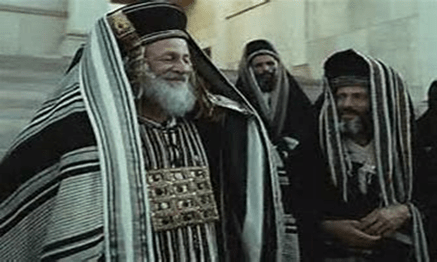
The Sadducees were extremely self-sufficient to the point of denying God’s involvement in everyday life. 2. They denied any resurrection of the dead. The Sadducees were a socio religious sect of Jews. The Sadducees were largely secular in their practice of religion.
WHOSE SON IS THE CHRIST?
While the Pharisees were gathered together, Jesus asked them, “What do you think about the Christ? Whose son is he?”
“The son of David,” they replied.
He said to them, “How is it then that David, speaking by the Spirit, calls him Lord? For he says, “The Lord said to my Lord “Sit at my right hand until I put your enemies under your feet.”
If then David calls him ‘Lord’, how can he be his son?” No one could say a word in reply and from that day no-one dared to ask him any more questions.
COMMENTS
(When Christ baffled his enemies, he asked what thoughts they had of the promised Messiah? How he could be the Son of David and yet his Lord? He quotes Ps 110:1. If the Christ was to be a mere man, who would not exist till many ages after David’s death, how could his forefather call him Lord? The Pharisees could not answer it. Nor can any solve the difficulty except he allows the Messiah to be the Son of God, and David’s Lord equally with the Father. He took upon him human nature, and so became God manifested in the flesh; in this sense he is the Son of man and the Son of David. It behoves us above all things seriously to inquire, What think we of Christ? Is he altogether glorious in our eyes, and precious to our hearts? May Christ be our joy, our confidence, our all. May we daily be made more like to him, and more devoted to his service.)
SEVEN WOES (to teachers of the law and Pharisees)
23:1-12 The scribes and Pharisees explained the law of Moses and enforced obedience to it. They are charged with hypocrisy in religion. We can only judge according to outward appearance; but God searches the heart. They made phylacteries. These were scrolls of paper or parchment, wherein were written four paragraphs of the law, to be worn on their foreheads and left arms, Ex 13:2-10; 13:11-16; De 6:4-9; 11:13-21. They made these phylacteries broad, that they might be thought more zealous for the law than others. God appointed the Jews to make fringes upon their garments, Nu 15:38, to remind them of their being a peculiar people; but the Pharisees made them larger than common, as if they were thereby more religious than others. Pride was the darling, reigning sin of the Pharisees, the sin that most easily beset them, and which our Lord Jesus takes all occasions to speak against. For him that is taught in the word to give respect to him that teaches, is commendable; but for him that teaches, to demand it, to be puffed up with it, is sinful. How much is all this against the spirit of Christianity! The consistent disciple of Christ is pained by being put into chief places. But who that looks around on the visible church, would think this was the spirit required? It is plain that some measure of this antichristian spirit prevails in every religious society, and in every one of our hearts.
23:13-33 The scribes and Pharisees were enemies to the gospel of Christ, and therefore to the salvation of the souls of men. It is bad to keep away from Christ ourselves, but worse also to keep others from him. Yet it is no new thing for the show and form of godliness to be made a cloak to the greatest enormities. But dissembled piety will be reckoned double iniquity. They were very busy to turn souls to be of their party. Not for the glory of God and the good of souls, but that they might have the credit and advantage of making converts. Gain being their godliness, by a thousand devices they made religion give way to their worldly interests. They were very strict and precise in smaller matters of the law, but careless and loose in weightier matters. It is not the scrupling a little sin that Christ here reproves; if it be a sin, though but a gnat, it must be strained out; but the doing that, and then swallowing a camel, or, committing a greater sin. While they would seem to be godly, they were neither sober nor righteous. We are really, what we are inwardly. Outward motives may keep the outside clean, while the inside is filthy; but if the heart and spirit be made new, there will be newness of life; here we must begin with ourselves. The righteousness of the scribes and Pharisees was like the ornaments of a grave, or dressing up a dead body, only for show. The deceitfulness of sinners’ hearts appears in that they go down the streams of the sins of their own day, while they fancy that they should have opposed the sins of former days. We sometimes think, if we had lived when Christ was upon earth, that we should not have despised and rejected him, as men then did; yet Christ in his Spirit, in his word, in his ministers, is still no better treated. And it is just with God to give those up to their hearts’ lusts, who obstinately persist in gratifying them. Christ gives men their true characters.
23:34-39 Our Lord declares the miseries the inhabitants of Jerusalem were about to bring upon themselves, but he does not notice the sufferings he was to undergo. A hen gathering her chickens under her wings, is an apt emblem of the Saviour’s tender love to those who trust in him, and his faithful care of them. He calls sinners to take refuge under his tender protection, keeps them safe, and nourishes them to eternal life. The present dispersion and unbelief of the Jews, and their future conversion to Christ, were here foretold. Jerusalem and her children had a large share of guilt, and their punishment has been signal. But ere long, deserved vengeance will fall on every church which is Christian in name only. In the meantime the Saviour stands ready to receive all who come to him. There is nothing between sinners and eternal happiness, but their proud and unbelieving unwillingness.
A Pharisee is a member of an ancient Jewish sect, distinguished by strict observance of the traditional and written law, and commonly held to have pretensions to superior sanctity.
- a self-righteous or hypocritical person.
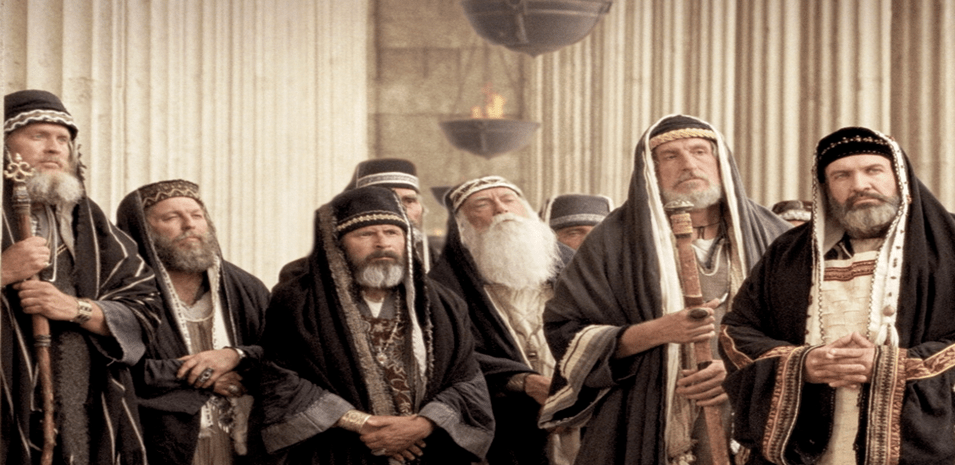
SIGNS OF THE END OF THE AGE
24 Jesus left the temple and was walking away when his disciples came up to him to call his attention to its buildings. 2 “Do you see all these things?” he asked. “Truly I tell you, not one stone here will be left on another; every one will be thrown down.”
3 As Jesus was sitting on the Mount of Olives, the disciples came to him privately. “Tell us,” they said, “when will this happen, and what will be the sign of your coming and of the end of the age?”
4 Jesus answered: “Watch out that no one deceives you. 5 For many will come in my name, claiming, ‘I am the Messiah,’ and will deceive many. 6 You will hear of wars and rumours of wars, but see to it that you are not alarmed. Such things must happen, but the end is still to come. 7 Nation will rise against nation, and kingdom against kingdom. There will be famines and earthquakes in various places. 8 All these are the beginning of birth pains.
9 “Then you will be handed over to be persecuted and put to death, and you will be hated by all nations because of me. 10 At that time many will turn away from the faith and will betray and hate each other, 11 and many false prophets will appear and deceive many people. 12 Because of the increase of wickedness, the love of most will grow cold, 13 but the one who stands firm to the end will be saved. 14 And this gospel of the kingdom will be preached in the whole world as a testimony to all nations, and then the end will come.
15 “So when you see standing in the holy place ‘the abomination ( a thing that causes disgust) that causes desolation,’[a] spoken of through the prophet Daniel—let the reader understand— 16 then let those who are in Judea flee to the mountains. 17 Let no one on the housetop go down to take anything out of the house. 18 Let no one in the field go back to get their cloak. 19 How dreadful it will be in those days for pregnant women and nursing mothers! 20 Pray that your flight will not take place in winter or on the Sabbath. 21 For then there will be great distress, unequalled from the beginning of the world until now—and never to be equalled again.
22 “If those days had not been cut short, no one would survive, but for the sake of the elect those days will be shortened. 23 At that time if anyone says to you, ‘Look, here is the Messiah!’ or, ‘There he is!’ do not believe it. 24 For false messiahs and false prophets will appear and perform great signs and wonders to deceive, if possible, even the elect. 25 See, I have told you ahead of time.
26 “So if anyone tells you, ‘There he is, out in the wilderness,’ do not go out; or, ‘Here he is, in the inner rooms,’ do not believe it. 27 For as lightning that comes from the east is visible even in the west, so will be the coming of the Son of Man. 28 Wherever there is a carcass, there the vultures will gather.
29 “Immediately after the distress of those days
“‘the sun will be darkened,
and the moon will not give its light;
the stars will fall from the sky,
and the heavenly bodies will be shaken.’[b]
30 “Then will appear the sign of the Son of Man in heaven. And then all the peoples of the earth[c] will mourn when they see the Son of Man coming on the clouds of heaven, with power and great glory.[d] 31 And he will send his angels with a loud trumpet call, and they will gather his elect from the four winds, from one end of the heavens to the other.
32 “Now learn this lesson from the fig tree: As soon as its twigs get tender and its leaves come out, you know that summer is near. 33 Even so, when you see all these things, you know that it[e] is near, right at the door. 34 Truly I tell you, this generation will certainly not pass away until all these things have happened. 35 Heaven and earth will pass away, but my words will never pass away. (Jesus’ word is like God’s word, abiding in truth and sureness.)
COMMENTS
(Note: Matthew flattens out the opposition to Jesus, which in fact came from several directions, and unifies it to correspond to the opponents of his own Church. But these woes are addressed also to his church to warn it against complacency. Ultimately here the Pharisees are accused of being false teachers because they do not accept the teaching mission of Jesus as the Christ.
The prophetic warning looks forward to the coming of the Son of Man with judgement and the kingdom. The apocalyptic discourse begins…. The beginning of the woes…called the birth pangs of the Messiah in Jewish apocalyptic…but for the elect, those whom God loves, especially those who suffer, God is in control, so that there is no reason for despair even in the midst of tribulations. God’s angels will become the agents of the Son of Man at the gathering of the elect from the entire universe.)
THE DAY AND THE HOUR UNKNOWN
36 “But about that day or hour no one knows, not even the angels in heaven, nor the Son,[a] but only the Father. (sharing our human condition, the Son shared also our partial ignorance)37 As it was in the days of Noah, so it will be at the coming of the Son of Man. 38 For in the days before the flood, people were eating and drinking, marrying and giving in marriage, up to the day Noah entered the ark; 39 and they knew nothing about what would happen until the flood came and took them all away. That is how it will be at the coming of the Son of Man. 40 Two men will be in the field; one will be taken and the other left. 41 Two women will be grinding with a hand mill; one will be taken and the other left. (Watchfulness, eschatological alertness to the will of God, is the main theme.)
42 “Therefore keep watch, because you do not know on what day your Lord will come. 43 But understand this: If the owner of the house had known at what time of night the thief was coming, he would have kept watch and would not have let his house be broken into. 44 So you also must be ready, because the Son of Man will come at an hour when you do not expect him.
45 “Who then is the faithful and wise servant, whom the master has put in charge of the servants in his household to give them their food at the proper time? 46 It will be good for that servant whose master finds him doing so when he returns. 47 Truly I tell you, he will put him in charge of all his possessions. 48 But suppose that servant is wicked and says to himself, ‘My master is staying away a long time,’ 49 and he then begins to beat his fellow servants and to eat and drink with drunkards. 50 The master of that servant will come on a day when he does not expect him and at an hour he is not aware of. 51 He will cut him to pieces and assign him a place with the hypocrites, where there will be weeping and gnashing of teeth.
THE PARABLE OF THE TEN VIRGINS
25 “At that time the kingdom of heaven will be like ten virgins (expectant believers) who took their lamps and went out to meet the bridegroom. 2 Five of them were foolish and five were wise. 3 The foolish ones took their lamps but did not take any oil with them. 4 The wise ones, however, took oil in jars along with their lamps. 5 The bridegroom was a long time in coming, and they all became drowsy and fell asleep. (absolute vigilance is not much the point, as readiness)
6 “At midnight the cry rang out: ‘Here’s the bridegroom! Come out to meet him!’ (the Son of Man is the Lord of surprises. The cry expresses the longing of the early church for the consummation of the kingdom. The oil stands for good works, foolish ones lack sufficient good works.)
7 “Then all the virgins woke up and trimmed their lamps. 8 The foolish ones said to the wise, ‘Give us some of your oil; our lamps are going out.’ (The refusal of the wise does not constitute lack of charity. The good works are not completely transferable. Others can help, but readiness to accept salvation is ultimately a matter of personal responsibility.)
9 “‘No,’ they replied, ‘there may not be enough for both us and you. Instead, go to those who sell oil and buy some for yourselves.’
10 “But while they were on their way to buy the oil, the bridegroom arrived. The virgins who were ready went in with him to the wedding banquet. And the door was shut.
11 “Later the others also came. ‘Lord, Lord,’ they said, ‘open the door for us!’
12 “But he replied, ‘Truly I tell you, I don’t know you.’
13 “Therefore keep watch, because you do not know the day or the hour.
NOTE: The wisdom in question is a practical wisdom about salvation.
THE PARABLE OF THE TALENTS
14 “Again, it will be like a man going on a journey, who called his servants and entrusted his wealth to them. 15 To one he gave five bags of gold, to another two bags, and to another one bag,[a] each according to his ability. Then he went on his journey. 16 The man who had received five bags of gold went at once and put his money to work and gained five bags more. 17 So also, the one with two bags of gold gained two more. 18 But the man who had received one bag went off, dug a hole in the ground and hid his master’s money.
19 “After a long time the master of those servants returned and settled accounts with them. 20 The man who had received five bags of gold brought the other five. ‘Master,’ he said, ‘you entrusted me with five bags of gold. See, I have gained five more.’
21 “His master replied, ‘Well done, good and faithful servant! You have been faithful with a few things; I will put you in charge of many things. Come and share your master’s happiness!’
22 “The man with two bags of gold also came. ‘Master,’ he said, ‘you entrusted me with two bags of gold; see, I have gained two more.’
23 “His master replied, ‘Well done, good and faithful servant! You have been faithful with a few things; I will put you in charge of many things. Come and share your master’s happiness!’
24 “Then the man who had received one bag of gold came. ‘Master,’ he said, ‘I knew that you are a hard man, harvesting where you have not sown and gathering where you have not scattered seed. 25 So I was afraid and went out and hid your gold in the ground. See, here is what belongs to you.’
26 “His master replied, ‘You wicked, lazy servant! So you knew that I harvest where I have not sown and gather where I have not scattered seed? 27 Well then, you should have put my money on deposit with the bankers, so that when I returned I would have received it back with interest.
28 “‘So take the bag of gold from him and give it to the one who has ten bags. 29 For whoever has will be given more, and they will have an abundance. Whoever does not have, even what they have will be taken from them. 30 And throw that worthless servant outside, into the darkness, where there will be weeping and gnashing of teeth.’
NOTE: The message of the parable in its present context offers a lifetime for the interim before the Son of Man returns, urging us to a responsible use of the master’s goods in view of the judgement to come. At an earlier stage, the story may have contained a reproach of a static (Sadducean) attitude to religious tradition, which refuses to develop it.
Gained: used in religious contexts for winning converts………..the other who hid his gold, hit his light, guarding the tradition in a static way. The gold may represent God’s mercy and glory …..to whoever is given has the responsibility to spread God’s message of mercy and salvation.
THE SHEEP AND THE GOATS
31 “When the Son of Man comes in his glory, and all the angels with him, he will sit on his glorious throne. 32 All the nations will be gathered before him, and he will separate the people one from another as a shepherd separates the sheep from the goats. 33 He will put the sheep on his right and the goats on his left.
34 “Then the King will say to those on his right, ‘Come, you who are blessed by my Father; take your inheritance, the kingdom prepared for you since the creation of the world. 35 For I was hungry and you gave me something to eat, I was thirsty and you gave me something to drink, I was a stranger and you invited me in, 36 I needed clothes and you clothed me, I was sick and you looked after me, I was in prison and you came to visit me.’
37 “Then the righteous will answer him, ‘Lord, when did we see you hungry and feed you, or thirsty and give you something to drink? 38 When did we see you a stranger and invite you in, or needing clothes and clothe you? 39 When did we see you sick or in prison and go to visit you?’
40 “The King will reply, ‘Truly I tell you, whatever you did for one of the least of these brothers and sisters of mine, you did for me.’
41 “Then he will say to those on his left, ‘Depart from me, you who are cursed, into the eternal fire prepared for the devil and his angels. 42 For I was hungry and you gave me nothing to eat, I was thirsty and you gave me nothing to drink, 43 I was a stranger and you did not invite me in, I needed clothes and you did not clothe me, I was sick and in prison and you did not look after me.’
44 “They also will answer, ‘Lord, when did we see you hungry or thirsty or a stranger or needing clothes or sick or in prison, and did not help you?’
45 “He will reply, ‘Truly I tell you, whatever you did not do for one of the least of these, you did not do for me.’
46 “Then they will go away to eternal punishment, but the righteous to eternal life.”
NOTE:- Apocalyptic revelation discourse with much dialogue. Jesus’ own concern for oneself preparing to enter the kingdom of heaven. A practical text presenting a practical religion of deeds and loving kindness….this is not a denial of faith: it is of the essence of faith. It represents service to the needy with much love of Christ. This binary thinking may offend some. It stems from the Deuteronomistic theology of a covenant conditioned by human obligation (as opposed to the covenant of unconditional divine commitment, represented in the NT by Paul’s theology.
The Plot Against Jesus
26 When Jesus had finished saying all these things, he said to his disciples, 2 “As you know, the Passover is two days away—and the Son of Man will be handed over to be crucified.” (Jesus shows prophetic knowledge of his destiny.) (Handed over to be crucified– -God is in control, the passion is part of the divine plan)
3 Then the chief priests and the elders of the people assembled in the palace of the high priest, whose name was Caiaphas, 4 and they schemed to arrest Jesus secretly and kill him. 5 “But not during the festival,” they said, “or there may be a riot among the people.”
Jesus Anointed at Bethany
6 While Jesus was in Bethany in the home of Simon the Leper, 7 a woman came to him with an alabaster jar of very expensive perfume, which she poured on his head as he was reclining at the table. ( the woman’s gesture is one of excess, appropriate to love and festivity, which the disciples fail to understand)
8 When the disciples saw this, they were indignant. “Why this waste?” they asked. 9 “This perfume could have been sold at a high price and the money given to the poor.”
10 Aware of this, Jesus said to them, “Why are you bothering this woman? She has done a beautiful thing to me. 11 The poor you will always have with you,[a] but you will not always have me. 12 When she poured this perfume on my body, she did it to prepare me for burial. 13 Truly I tell you, wherever this gospel is preached throughout the world, what she has done will also be told, in memory of her.”
( wherever this gospel……this refers specifically to the message of the suffering, death and resurrection ) (in memory of her…….Historically women’s work has usually gone unrecorded (and unrewarded). Jesus sets himself against this injustice. His recognition of women is returned at the cross.)
Judas Agrees to Betray Jesus
14 Then one of the Twelve—the one called Judas Iscariot—went to the chief priests 15 and asked, “What are you willing to give me if I deliver him over to you?” So they counted out for him thirty pieces of silver. 16 From then on Judas watched for an opportunity to hand him over.
Here, Matthew sets up a contrast between the woman’s loyal love and the apostle’s betrayal. Judas bargains away his Messiah and the priests pay immediately. They weighed thirty pieces of silver…(.all occurs according to the divine plan. (Exod21:32 we find “If the bull gores (sheds blood) a male of female slave, the owner must pay thirty shekels of silver to the master of the slave,,,)
The Last Supper
17 On the first day of the Festival of Unleavened Bread, the disciples came to Jesus and asked, “Where do you want us to make preparations for you to eat the Passover?” (preparations: the whole feast lasted a week and a day. The city was jammed with pilgrims who rented space. The pilgrims are calculated at about 30,000 so the reservations were necessary.)
18 He replied, “Go into the city to a certain man and tell him, ‘The Teacher says: My appointed time is near. I am going to celebrate the Passover with my disciples at your house.’” 19 So the disciples did as Jesus had directed them and prepared the Passover.
20 When evening came, Jesus was reclining at the table with the Twelve. 21 And while they were eating, he said, “Truly I tell you, one of you will betray me.”
22 They were very sad and began to say to him one after the other, “Surely you don’t mean me, Lord?”
23 Jesus replied, “The one who has dipped his hand into the bowl with me will betray me. 24 The Son of Man will go just as it is written about him. But woe to that man who betrays the Son of Man! It would be better for him if he had not been born.” (Jesus knows exactly who the traitor is. This verse is unique to Matthew and serves as the direct confrontation of the betrayal and the betrayed.)
25 Then Judas, the one who would betray him, said, “Surely you don’t mean me, Rabbi?”
Jesus answered, “You have said so.”
26 While they were eating, Jesus took bread, and when he had given thanks, he broke it and gave it to his disciples, saying, “Take and eat; this is my body.” (the Eucharistic rite to the impending death on the cross as of atoning saving significance) (Jesus identifies the elements of his meal with his broken and bleeding body on the cross)
27 Then he took a cup, and when he had given thanks, he gave it to them, saying, “Drink from it, all of you. 28 This is my blood of the[a] covenant, which is poured out for many for the forgiveness of sins. 29 I tell you, I will not drink from this fruit of the vine from now on until that day when I drink it new with you in my Father’s kingdom.”
30 When they had sung a hymn, they went out to the Mount of Olives.
Jesus Predicts Peter’s Denial
31 Then Jesus told them, “This very night you will all fall away on account of me, for it is written:
“‘I will strike the shepherd,
and the sheep of the flock will be scattered.’[a]
32 But after I have risen, I will go ahead of you into Galilee.”
33 Peter replied, “Even if all fall away on account of you, I never will.”
34 “Truly I tell you,” Jesus answered, “this very night, before the rooster crows, you will disown me three times.”
35 But Peter declared, “Even if I have to die with you, I will never disown you.” And all the other disciples said the same.
(Jesus makes three predictions: a) the cowardly betrayal; b) the resurrection and its aftermath; c) the denial of impulsive Peter)
GETHSEMANE
36 Then Jesus went with his disciples to a place called Gethsemane, and he said to them, “Sit here while I go over there and pray.” 37 He took Peter and the two sons of Zebedee along with him, and he began to be sorrowful and troubled. 38 Then he said to them, “My soul is overwhelmed with sorrow to the point of death. Stay here and keep watch with me.”
39 Going a little farther, he fell with his face to the ground and prayed, “My Father, if it is possible, may this cup be taken from me. Yet not as I will, but as you will.”
40 Then he returned to his disciples and found them sleeping. “Couldn’t you men keep watch with me for one hour?” he asked Peter. 41 “Watch and pray so that you will not fall into temptation. The spirit is willing, but the flesh is weak.”
42 He went away a second time and prayed, “My Father, if it is not possible for this cup to be taken away unless I drink it, may your will be done.”
43 When he came back, he again found them sleeping, because their eyes were heavy. 44 So he left them and went away once more and prayed the third time, saying the same thing.
45 Then he returned to the disciples and said to them, “Are you still sleeping and resting? Look, the hour has come, and the Son of Man is delivered into the hands of sinners. 46 Rise! Let us go! Here comes my betrayer!”
(Jesus ‘hour had come…and in full submission to the will of the Father. The effect of the prayer is that now Jesus can face his enemies) (spiritual strength)
Jesus Arrested
The hour of Jesus’ tragic destiny.
47 While he was still speaking, Judas, one of the Twelve, arrived. With him was a large crowd armed with swords and clubs, sent from the chief priests and the elders of the people. 48 Now the betrayer had arranged a signal with them: “The one I kiss is the man; arrest him.” 49 Going at once to Jesus, Judas said, “Greetings, Rabbi!” and kissed him.
50 Jesus replied, “Do what you came for, friend.”[a] (by using a kiss as a signal for arrest, Judas perverts a gesture of friendship)
Then the men stepped forward, seized Jesus and arrested him. 51 With that, one of Jesus’ companions reached for his sword, drew it out and struck the servant of the high priest, cutting off his ear. (A disciple cuts off the earlobe of the high priest’s servant. This is not an accident in a scuffle but a deliberately symbolic gesture. The servant was not a minor domestic but vice-president of the Temple administration. He does represent the high priest. A mutilated ear disqualifies one from serving as high priest. Thus, the gesture says that a priest who would arrest God’s emissary is unfit for office (spiritually bankrupt)
52 “Put your sword back in its place,” Jesus said to him, “for all who draw the sword will die by the sword. (Jesus’ preference for nonviolent resistance. ) Do you think I cannot call on my Father, and he will at once put at my disposal more than twelve legions of angels? 54 But how then would the Scriptures be fulfilled that say it must happen in this way?”
55 In that hour Jesus said to the crowd, “Am I leading a rebellion, that you have come out with swords and clubs to capture me? Every day I sat in the temple courts teaching, and you did not arrest me. 56 But this has all taken place that the writings of the prophets might be fulfilled.” Then all the disciples deserted him and fled. (This abandonment by his followers was cause for pain equal to his physical suffering)
Jesus Before the Sanhedrin
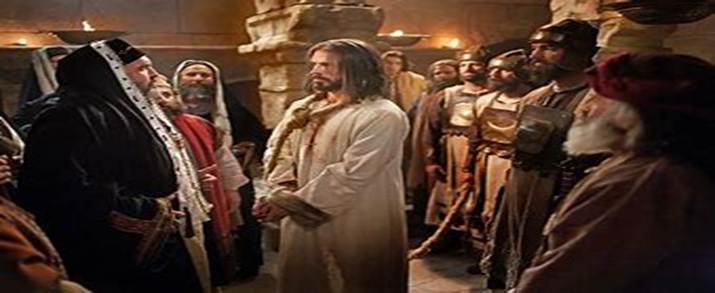
57 Those who had arrested Jesus took him to Caiaphas the high priest, where the teachers of the law and the elders had assembled. 58 But Peter followed him at a distance, right up to the courtyard of the high priest. He entered and sat down with the guards to see the outcome.
59 The chief priests and the whole Sanhedrin were looking for false evidence against Jesus so that they could put him to death. 60 But they did not find any, though many false witnesses came forward.
Finally, two came forward 61 and declared, “This fellow said, ‘I am able to destroy the temple of God and rebuild it in three days.’”
62 Then the high priest stood up and said to Jesus, “Are you not going to answer? What is this testimony that these men are bringing against you?” 63 But Jesus remained silent.
The high priest said to him, “I charge you under oath by the living God: Tell us if you are the Messiah, the Son of God.”
64 “You have said so,” Jesus replied. “But I say to all of you: From now on you will see the Son of Man sitting at the right hand of the Mighty One and coming on the clouds of heaven.”[a]
65 Then the high priest tore his clothes and said, “He has spoken blasphemy! (Blasphemy was punished by death) Why do we need any more witnesses? Look, now you have heard the blasphemy. 66 What do you think?”
“He is worthy of death,” they answered.
67 Then they spit in his face and struck him with their fists. Others slapped him 68 and said, “Prophesy to us, Messiah. Who hit you?”
Peter Disowns Jesus
69 Now Peter was sitting out in the courtyard, and a servant girl came to him. “You also were with Jesus of Galilee,” she said.
70 But he denied it before them all. “I don’t know what you’re talking about,” he said.
71 Then he went out to the gateway, where another servant girl saw him and said to the people there, “This fellow was with Jesus of Nazareth.”
72 He denied it again, with an oath: “I don’t know the man!”
73 After a little while, those standing there went up to Peter and said, “Surely you are one of them; your accent gives you away.”
74 Then he began to call down curses, and he swore to them, “I don’t know the man!”
Immediately a rooster crowed. 75 Then Peter remembered the word Jesus had spoken: “Before the rooster crows, you will disown me three times.” And he went outside and wept bitterly. (Jesus’ prophesy fulfilled)
Judas Hangs Himself
27 Early in the morning, all the chief priests and the elders of the people made their plans how to have Jesus executed. 2 So they bound him, led him away and handed him over to Pilate the governor.
3 When Judas, who had betrayed him, saw that Jesus was condemned, he was seized with remorse and returned the thirty pieces of silver to the chief priests and the elders. 4 “I have sinned,” he said, “for I have betrayed innocent blood.”
“What is that to us?” they replied. “That’s your responsibility.”
5 So Judas threw the money into the temple and left. Then he went away and hanged himself.
6 The chief priests picked up the coins and said, “It is against the law to put this into the treasury, since it is blood money.” 7 So they decided to use the money to buy the potter’s field as a burial place for foreigners. 8 That is why it has been called the Field of Blood to this day. 9 Then what was spoken by Jeremiah the prophet was fulfilled: “They took the thirty pieces of silver, the price set on him by the people of Israel, 10 and they used them to buy the potter’s field, as the Lord commanded me.”[a]
(Judas’ suicide can be understood as a case of anomie (In sociology, anomie is a social condition defined by an uprooting or breakdown of any moral values, standards or guidance for individuals to follow.) , a loss of moral bearings once he betrayed his centre of meaning.
The Potter’s field (of blood) A potter’s field, paupers’ grave or common grave is a place for the burial of unknown, unclaimed or indigent people. “Potter’s field” is of Biblical origin, referring to Akeldama (meaning field of blood in Aramaic), stated to have been purchased after Judas Iscariot’s suicide, purchased by the high priests of Jerusalem.
Jesus Before Pilate
11 Meanwhile Jesus stood before the governor, and the governor asked him, “Are you the king of the Jews?”
“You have said so,” Jesus replied.
12 When he was accused by the chief priests and the elders, he gave no answer. 13 Then Pilate asked him, “Don’t you hear the testimony they are bringing against you?” 14 But Jesus made no reply, not even to a single charge—to the great amazement of the governor.
15 Now it was the governor’s custom at the festival to release a prisoner chosen by the crowd. 16 At that time they had a well-known prisoner whose name was] Barabbas. 17 So when the crowd had gathered, Pilate asked them, “Which one do you want me to release to you: Jesus Barabbas, or Jesus who is called the Messiah?” 18 For he knew it was out of self-interest that they had handed Jesus over to him.
19 While Pilate was sitting on the judge’s seat, his wife sent him this message: “Don’t have anything to do with that innocent man, for I have suffered a great deal today in a dream because of him.” (Pilate’s wife dream represents a redactional (rectification) insertion. Dreams in Matthew furnish divine guidance: innocent. Jesus is just.) Pilate remains ultimately responsible despite Matthew ‘s redactional efforts)
20 But the chief priests and the elders persuaded the crowd to ask for Barabbas and to have Jesus executed.
21 “Which of the two do you want me to release to you?” asked the governor.
“Barabbas,” they answered.
22 “What shall I do, then, with Jesus who is called the Messiah?” Pilate asked.
They all answered, “Crucify him!”
23 “Why? What crime has he committed?” asked Pilate.
But they shouted all the louder, “Crucify him!”
24 When Pilate saw that he was getting nowhere, but that instead an uproar was starting, he took water and washed his hands in front of the crowd. “I am innocent of this man’s blood,” he said. “It is your responsibility!”
25 All the people answered, “His blood is on us and on our children!”
26 Then he released Barabbas to them. But he had Jesus flogged and handed him over to be crucified.
The Soldiers Mock Jesus
27 Then the governor’s soldiers took Jesus into the Praetorium and gathered the whole company of soldiers around him. 28 They stripped him and put a scarlet robe on him, 29 and then twisted together a crown of thorns and set it on his head. They put a staff in his right hand. Then they knelt in front of him and mocked him. “Hail, king of the Jews!” they said. 30 They spit on him and took the staff and struck him on the head again and again. 31 After they had mocked him, they took off the robe and put his own clothes on him. Then they led him away to crucify him.
The mocking of Jesus as king is a gesture of momentary moral chaos with affinities to the Roman Saturnalia festival (Saturnalia is an ancient Roman festival and holiday in honour of the god Saturn, held on 17 December of the Julian calendar and later expanded with festivities through to 23 December. and to all the mock king occasions going back to ancient Babylonia.)
The Crucifixion of Jesus
32 As they were going out, they met a man from Cyrene, named Simon, and they forced him to carry the cross. 33 They came to a place called Golgotha (which means “the place of the skull”- a small stone hill just outside the city walls near an abandoned quarry)). 34 There they offered Jesus wine to drink, mixed with gall; but after tasting it, he refused to drink it. 35 When they had crucified him, they divided up his clothes by casting lots. 36 And sitting down, they kept watch over him there. 37 Above his head they placed the written charge against him: this is jesus, the king of the jews. (the legal grounds for his execution – The title would be read different by Jews and Romans, the first seeing it as a claim to be messiah, the second as the token of rebellion against the emperor.)
38 Two rebels were crucified with him, one on his right and one on his left. 39 Those who passed by hurled insults at him, shaking their heads 40 and saying, “You who are going to destroy the temple and build it in three days, save yourself! Come down from the cross, if you are the Son of God!” 41 In the same way the chief priests, the teachers of the law and the elders mocked him. 42 “He saved others,” they said, “but he can’t save himself! He’s the king of Israel! Let him come down now from the cross, and we will believe in him. 43 He trusts in God. Let God rescue him now if he wants him, for he said, ‘I am the Son of God.’” 44 In the same way the rebels who were crucified with him also heaped insults on him.
Three groups deride (express contempt) Jesus: passers-by, the authorities and the robbers. The humiliating, inglorious excruciating death shatters any mythic (fictional or illusory) tendency in the life of Jesus. A slave’s death on the cross is not poetry but bitter historical reality.
From a Christian ‘s faith viewpoint Jesus is saviour not by evading the cross but by enduring it.
The Death of Jesus
45 From noon until three in the afternoon darkness came over all the land. 46 About three in the afternoon Jesus cried out in a loud voice, “Eli, Eli,[a] lema sabachthani?” (which means “My God, my God, why have you forsaken me?”).[b]
47 When some of those standing there heard this, they said, “He’s calling Elijah.”
48 Immediately one of them ran and got a sponge. He filled it with wine vinegar, put it on a staff, and offered it to Jesus to drink. 49 The rest said, “Now leave him alone. Let’s see if Elijah comes to save him.”
50 And when Jesus had cried out again in a loud voice, he gave up his spirit. (the voluntary nature of Jesus’ death)
51 At that moment the curtain of the temple was torn in two from top to bottom. (the torn veil symbolises a new era of salvation history, in which the temple would not be a building) The earth shook, the rocks split 52 and the tombs broke open. The bodies of many holy people who had died were raised to life. 53 They came out of the tombs after Jesus’ resurrection and[c] went into the holy city and appeared to many people. (Jesus’ death is life giving)
54 When the centurion and those with him who were guarding Jesus saw the earthquake and all that had happened, they were terrified, and exclaimed, “Surely he was the Son of God!”
Note: My God, my God, why have you abandoned me, but not despair.
55 Many women were there, watching from a distance. They had followed Jesus from Galilee to care for his needs. 56 Among them were Mary Magdalene, Mary the mother of James and Joseph,[d] and the mother of Zebedee’s sons. (The presence of the faithful and courageous women contrasts with the absence of the twelve and shows the power of love)
The Burial of Jesus
57 As evening approached, there came a rich man from Arimathea, named Joseph, who had himself become a disciple of Jesus. 58 Going to Pilate, he asked for Jesus’ body, and Pilate ordered that it be given to him. 59 Joseph took the body, wrapped it in a clean linen cloth, 60 and placed it in his own new tomb that he had cut out of the rock. He rolled a big stone in front of the entrance to the tomb and went away. 61 Mary Magdalene and the other Mary were sitting there opposite the tomb.
(In general, the burial serves to underline the reality of the death of Jesus and to prepare for the account of the resurrection)
Pilate Sets a Guard
62 On the next day, which followed the Day of Preparation, the chief priests and Pharisees gathered together to Pilate, 63 saying, “Sir, we remember, while He was still alive, how that deceiver said, ‘After three days I will rise.’ 64 Therefore command that the tomb be made secure until the third day, lest His disciples come [a]by night and steal Him away, and say to the people, ‘He has risen from the dead.’ So the last deception will be worse than the first.”
65 Pilate said to them, “You have a guard; go your way, make it as secure as you know how.” 66 So they went and made the tomb secure, sealing the stone and setting the guard.
Jesus Has Risen (THE RESURRECTION)
28 After the Sabbath, at dawn on the first day of the week, Mary Magdalene and the other Mary went to look at the tomb.
2 There was a violent earthquake, for an angel of the Lord came down from heaven and, going to the tomb, rolled back the stone and sat on it. 3 His appearance was like lightning, and his clothes were white as snow. 4 The guards were so afraid of him that they shook and became like dead men.
(The stone blocking the tomb was the monument of death. Rolled back with the guard sitting upon it, it becomes the symbol of victory over death. Like the virginal conception it is a small outward sign of a greater invisible reality).
5 The angel said to the women, “Do not be afraid, for I know that you are looking for Jesus, who was crucified. 6 He is not here; he has risen, just as he said. Come and see the place where he lay. 7 Then go quickly and tell his disciples: ‘He has risen from the dead and is going ahead of you into Galilee. There you will see him.’ Now I have told you.”
8 So the women hurried away from the tomb, afraid yet filled with joy, and ran to tell his disciples. 9 Suddenly Jesus met them. “Greetings,” he said. They came to him, clasped his feet and worshiped him. 10 Then Jesus said to them, “Do not be afraid. Go and tell my brothers to go to Galilee; there they will see me.” (that they will see the Lord in Galilee suggests that they have been forgiven for their betrayal and that Galilee is a place of victory and grace.)
(The personal vindication of Jesus through God’s raising him from the dead bodily. This event, accessible only to faith, is not yet the fullness of the kingdom on earth, but it points to the permanent kingdom of heaven.)
The discovery of the empty tomb is not absolutely essential to the bare minimum of Christian faith, but is an external support for that faith.
The Guards’ Report
11 While the women were on their way, some of the guards went into the city and reported to the chief priests everything that had happened. 12 When the chief priests had met with the elders and devised a plan, they gave the soldiers a large sum of money, 13 telling them, “You are to say, ‘His disciples came during the night and stole him away while we were asleep.(a bribe with a lie)’ 14 If this report gets to the governor, we will satisfy him and keep you out of trouble.”(for the guards should have been guarding the tomb and their dereliction of duty could entail maximum penalties) 15 So the soldiers took the money and did as they were instructed. And this story has been widely circulated among the Jews to this very day.
The Great Commission
16 Then the eleven disciples went to Galilee, to the mountain where Jesus had told them to go. 17 When they saw him, they worshiped him; but some doubted. 18 Then Jesus came to them and said, “All authority in heaven and on earth has been given to me. 19 Therefore go and make disciples of all nations, baptizing them in the name of the Father and of the Son and of the Holy Spirit, 20 and teaching them to obey everything I have commanded you. And surely, I am with you always, to the very end of the age.”
Conclusion: An anticipated Parousia (another term for second coming), a partial fulfilment of Daniel’s vision of the Son of Man. The mountain is the mountain of revelation where Jesus touched them.(Sermon of the Mount) The farewell words of Jesus may be divided into three parts, which refer respectively to past, present and future. ‘all authority has been given me’ …..it is God who has bestowed divine authority on Jesus as Son of Man. The authority is that of the kingdom of God. Go therefore………the great missionary commission concerns the present. It contains a general command to go forth and make disciples, the present, and then the future ….to all nations. Teaching them all that I have commanded you. The disciples are to carry on Jesus’ teaching ministry, thus laying the foundation for Christian education, theology, and other intellectual work.
The last verse, ‘I am with you always reveals the entire task as daunting that a promise of future support is necessary. The close of age……this refers to the coming of the kingdom of God in its fullness.
Commentary source: The new Jerome Biblical Commentary/Thompson Chain Reference Bible and other approved Catholic sources.

Leave a comment