
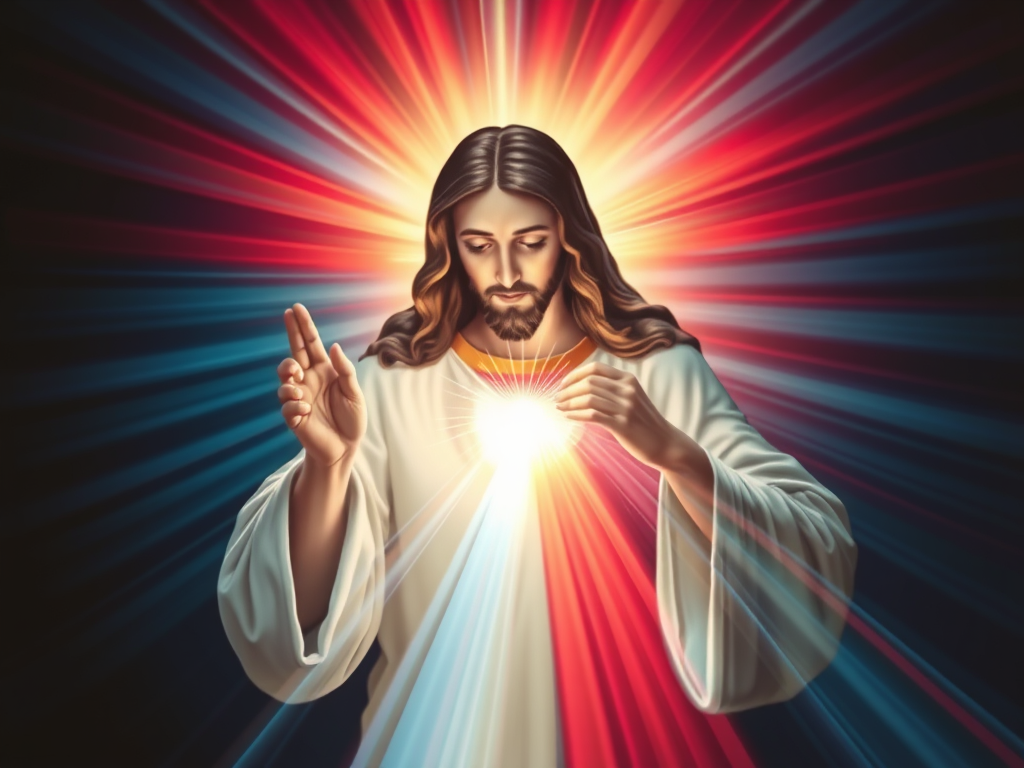
The Resurrection of Jesus was the most important event in the history of the world. When the Lord appeared in the ‘Upper Room’ to the apostles pointing out his wounds, it was to demonstrate He was the Crucified Christ, and to show he had resurrected from the dead. The final proof that he was God. He then bestowed on the apostles the power to forgive sins, which was in effect Divine Mercy coming into the world.
It was the beginning of the Church on earth. In 1931 He appeared as the same image in another room, this time the room of a young nun, Sister Faustina, again showing His wounds, emphasising the power of those wounds as rays from a font of reconciliation and renewal, rays of love and mercy. This was the Divine Mercy, His victory on the Cross, His resurrection, coming to a very sinful world once again. A world that was about to plunge man into the depths of depravity in a horrific world war.
He asked her to teach the world again of why He died on the Cross to give sinners another chance of obtaining God’s Divine Mercy and pardon their sins if they returned to living by God’s commandments.
The commandments of God are built into every human born, in the form of a conscience that was given them at birth, it is the spirit of God within them, if you deny your conscience, you deny God.
In the beginning he said, “I have not come to call the righteous, but to call sinners to repentance”. (Luke 5:32) For the same reason He appeared again on earth to Sister Faustina, to save sinners from eternal damnation. His message of Divine Mercy is a warning to mankind to exercise their conscience, come back to God and live by the commandments and the Gospel Truth.
Saint John Paul II canonised Sr. Faustina in 2000 making her the “first saint of the new millennium. Speaking of Sr. Faustina and the importance of the message contained in her Diary, the Pope called her “the great apostle of Divine Mercy in our time”
In a reflection by Fr Michael Najim, a pastor of St. Philip Church in Greenville, he points out that ‘Divine Mercy’ is the way of freedom. It is not the political freedom he is referring to, especially in a time where regimes still exist where citizens have no freedom at all, but he is referring to something more important: interior, spiritual freedom, the freedom to live a truly happy and virtuous life, free from slavery to sin and darkness. People who lives are habitually sinful become enslaved to sin.
True freedom is not the choice to do whatever I want. It is not allowing my passions and emotions to dictate every decision, including my very identity. True freedom is freedom for excellence, freedom to live a life of virtue. True freedom is the ability to say no to temptation and sin and yes to Christ and virtue.
We are all to some extent, struggling with sin and darkness, or feel enslaved. It is a time to open our heart to the Lord’s mercy through the sacrament of reconciliation and receiving the Lord’s liberating forgiveness.
Published in the Sunday Times of Malta (April 2025)
Gordon Vassallo

Leave a comment